




By Lenah Bosibori
As climate change, post-harvest losses and rising production costs continue to threaten Africa’s food systems, a new generation of innovators is developing practical homegrown solutions to help farmers adapt.
From AI-powered SMS platforms connecting remote farmers to agronomists, to homemade biofertilizers replacing expensive chemical inputs, and initiatives supporting women tractor owners and sustainable fish production in the Lake Victoria Basin, these innovations are designed to improve food security, strengthen farmers’ incomes and build climate resilience.
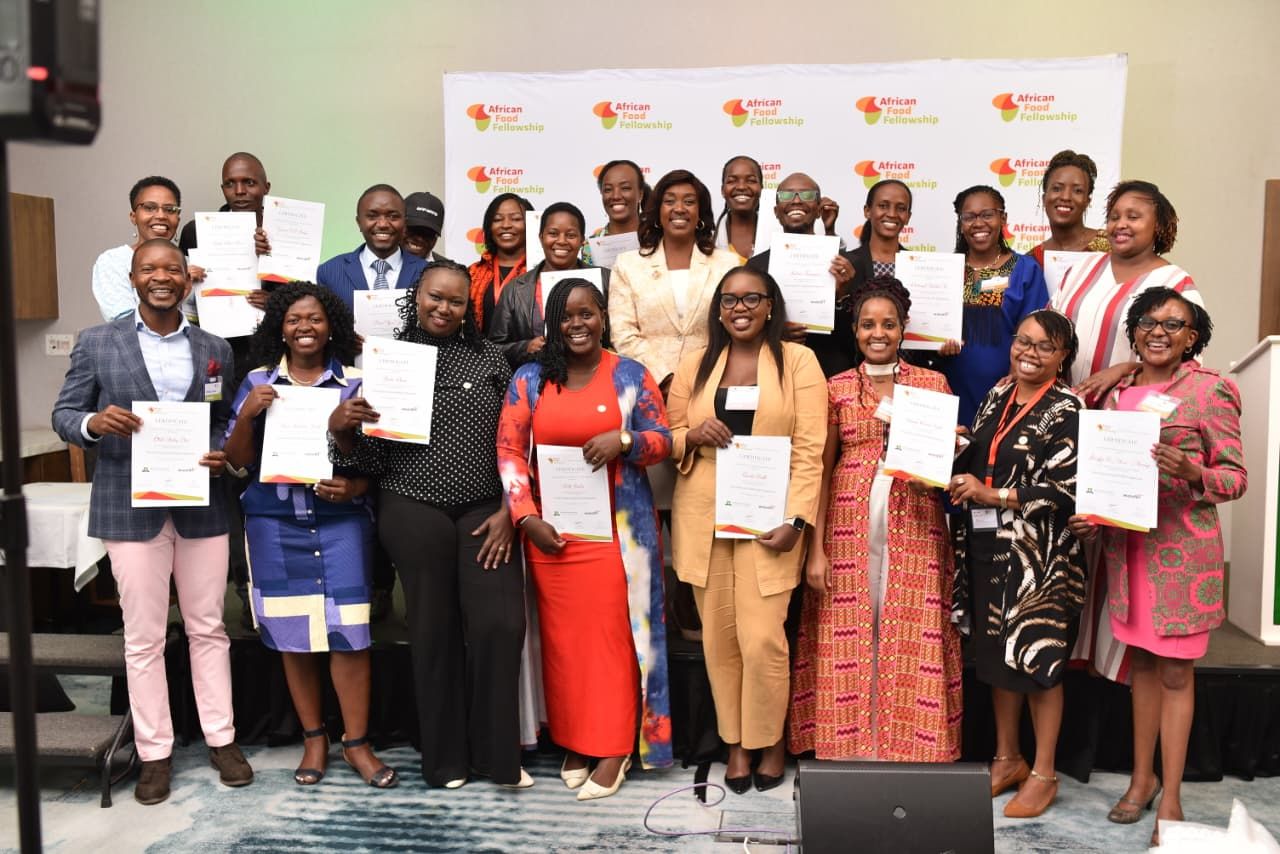
The ideas took centre stage during the graduation of the fifth cohort of the African Food Fellowship (AFF), where 23 Kenyan Fellows unveiled their Food Systems Actions, practical innovations developed through a 10-month leadership programme that brings together researchers, entrepreneurs, policymakers and farmers to solve some of Africa’s most persistent food system challenges.
Among the fellows showcasing innovative solutions was agricultural economist Anna Kimeu, who is determined to tackle one of Kenya’s biggest food system challenges. “Nearly 40 per cent of food produced in sub-Saharan Africa is lost before it reaches consumers,” she says. “The wastage hurts me.”
Kimeu says growing up on a coffee farm shaped her passion for agriculture. Proudly calling herself “a farmer’s daughter,” she credits farming with paying her school fees and laying the foundation for her career.
Today, she is developing two innovations aimed at helping smallholder farmers become more profitable. One is FarmNova, a digital platform linking farmers to agronomists, markets and agricultural inputs. The second focuses on reducing post-harvest losses through value addition.
She believes many farmers struggle not because they cannot produce food, but because they lack timely information. “Farming is a business,” she says. “Farmers need information just as much as they need quality seeds.”
Her passion has also inspired her 14-year-old daughter, Fiona Mailu, a Grade Nine student already designing agricultural solutions of her own.
After watching a relative lose an entire tomato crop because he lacked access to timely agricultural advice, Fiona asked a simple question. “If information exists online, why can’t farmers without internet access receive it?” Mailu queries.
Her answer became an AI-assisted SMS platform that delivers farming advice through ordinary text messages, making agricultural knowledge accessible even to farmers without smartphones or internet connectivity.
“Human agronomists verify the information generated by artificial intelligence before it reaches farmers,” Mailu explains. “That ensures every recommendation is accurate and relevant to local farming conditions.”
She believes young people have a critical role to play in transforming agriculture.
“Agricultural productivity will only improve when young people become part of the solution. As students, we have both the ideas and the responsibility to help transform agriculture in Kenya and across Africa.”
Mailu’s innovation has already progressed through the Kenya Young Scientists competition.
Feeding the soil
Dr Janet Chepkemoi, a soil scientist and lecturer at the University of Nairobi, believes the key to improving food production lies beneath farmers’ feet.
“Every day, farmers struggle to put food on their tables while often overlooking the economic potential of agriculture,” she says. “Climate-smart farming should not only increase food production but also protect the environment.”
She is encouraging farmers to reduce dependence on costly synthetic fertilisers by producing organic biofertilizers from food waste, livestock manure and crop residues. “Feed the soil so the soil can feed you.”
Dr Chepkemoi warns that applying more fertiliser does not necessarily result in higher yields. “Farmers should aim for optimum production, not maximum production. Chasing maximum yields often leads to excessive fertiliser use, which degrades soil health, reduces long-term productivity and harms the environment.”
Instead, she promotes agroecology in schools and urban communities, where learners produce compost, liquid fertilisers and nutritious food while restoring soil health.
Banana peels, she explains, can be fermented into phosphorus-rich foliar fertiliser, while kitchen waste and livestock manure can be converted into valuable compost instead of ending up as waste.
Her Food Systems Action seeks to establish demonstration farms where communities can learn practical climate-smart farming techniques and affordable soil restoration methods.
Building leaders for Africa’s food systems
According to Gachoki Kipruto, Country Lead for the African Food Fellowship Kenya, the innovations presented by the graduates demonstrate the kind of leadership Africa needs to build resilient food systems.
“The Fellowship brings together leaders from across the food system to tackle the root causes of food insecurity rather than simply responding to its symptoms,” she says.
The programme identifies systemic barriers, including weak policy implementation, unequal access to opportunities, limited investment and financing gaps, then equips Fellows to develop collaborative solutions that create lasting impact.
Implemented in Kenya, Rwanda and Zambia, the Fellowship brings together professionals from government, academia, agribusiness, civil society and farming communities.
“Our goal is to transform Africa’s food systems by addressing the persistent challenges that continue to hold them back,” Kipruto says.
The Fellowship currently focuses on three strategic priorities: inclusive horticulture markets, the blue economy for food and agricultural finance.
Under the horticulture pillar, Fellows work to help smallholder farmers overcome barriers to quality inputs, markets, financing and access to practical research.
“Research should not remain in academic journals,” Kipruto says. “It must be translated into knowledge that farmers can use to improve productivity and incomes.”
The programme also brings together experts in forestry, research, policymaking, entrepreneurship, agribusiness and development to strengthen agricultural value chains.
Within the blue economy, Fellows are exploring opportunities in marine fisheries, lake resources and inland aquaculture to improve food security while promoting the sustainable management of aquatic resources.
“We are not trying to solve every challenge at once,” Kipruto says. “We are focusing on the stubborn problems that stand in the way of healthy, resilient and inclusive food systems across Africa.”