



By Lenah Bosibori
As the country gears up for global conversations on the shift from fossil fuels to clean energy, young people have heightened their innovations in support of the government’s intention.
Bilha Beatrice Akoth, a first-year student at the Technical University of Kenya, was among the many young people gathered at the energy transition summit in Nairobi. Akoth, who is pursuing a Bachelor’s degree in International Relations and Diplomacy and serves as the vice chairperson of the university’s environmental club, says attending a recent energy transition summit changed how she sees her role in climate action.
“I attended today’s summit and learned about renewable energy and its impact on our daily lives,” she said. “I will share this knowledge with my club members and also when I go back to my village, because this is how we can build a better life for everyone while conserving our environment.”
Her voice reflects a growing movement among young people in Kenya who are stepping into conversations traditionally dominated by policymakers, experts, and civil society organizations.
Akoth believes one of the biggest barriers to renewable energy adoption in Kenya is lack of awareness, especially in rural areas. “Most people do not know about renewable energy sources,” she said. “This information is mostly known by people living in cities, while those in villages are left out.”
She adds that this gap has slowed progress. “Lack of knowledge is what is holding us back. We need to spread this message everywhere so that communities can understand and adopt clean energy solutions.”
Her concern echoes a broader reality in Kenya, where access to information often determines access to opportunity.
Beyond Policy to People
Akoth also emphasizes the role of leadership in driving change. “Our leaders have a key role to play in ensuring that our environment is protected,” she said. “They need to align with our vision and support renewable energy.”
She reiterates that change is not only about policy but also about people. “It is important to include young voices and even religious groups in environmental conservation,” she said. “When we take care of the environment, we are doing God’s work.”
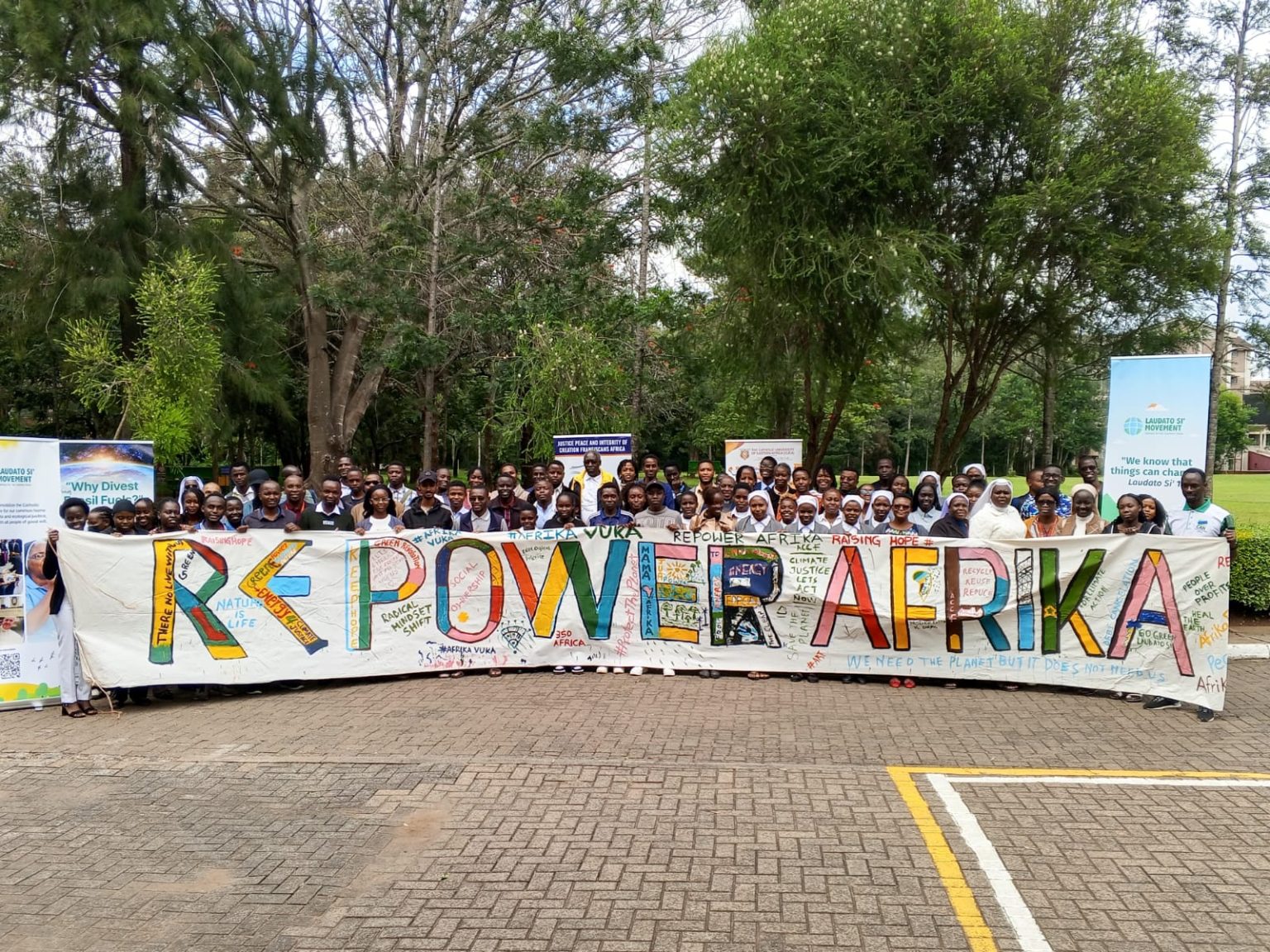
Her perspective was echoed during an energy transition workshop held at the Catholic University of Eastern Africa, where students, faith leaders, and climate advocates gathered to push for a just energy transition.
The meeting brought together participants from different universities and organizations, many of them calling for urgent action to move away from fossil fuels.
In a joint declaration, faith-based groups and youth organizations described the transition to clean energy as both a moral and practical necessity. “We transition because we must,” the declaration stated. “The cost of inaction measured in lives lost, livelihoods destroyed, and futures foreclosed far exceeds the cost of change.”
The declaration emphasized that renewable energy such as solar, wind, and geothermal offers an opportunity to build a system that is cleaner, more equitable, and more resilient.
Steveen Kezamutima of the Laudato Si Movement said that the push for renewable energy goes beyond technology.
“Laudato Si’” is Italian for “Praise be to you”, taken from a prayer by St. Francis of Assisi, celebrating care for creation.
“Our work is grounded in the vision of a just transition,” he said. “This means moving toward an ethical energy future that ends the expansion and use of fossil fuels.”
He added that renewable energy represents more than an alternative. “It is a response to injustice and it offers a pathway to dignity, resilience, and energy sovereignty for communities.”
Faith leaders at the event also highlighted the moral responsibility tied to environmental protection.
Fr. Dr Peter Mbaro a senior lecturer at The Catholic University of Eastern Africa in the Centre for Social Justice and Ethics noted that energy choices are deeply ethical decisions.
“Everything we do has a moral dimension,” he said. “Responding to the fossil fuel crisis is not optional. It is an ethical obligation.”
Energy Access and Inequality
The discussions also highlighted the broader challenge facing Africa.
More than 600 million people across the continent still lack access to electricity, making energy access not just an environmental issue, but a development one.
“Energy is directly linked to health, education, and economic growth,” one speaker noted. “Without it, development remains out of reach,” noted Dr Mbaro.
Kenya, however, was described as being in a strong position to lead the transition due to its growing investment in renewable energy.
Participants emphasized that while global conversations on climate change are important, real change must happen at the community level. “Energy transition begins at every level from national policy to household choices,” Kezamutima said.
Simple solutions such as clean cooking technologies, biogas, and solar energy were highlighted as practical steps communities can adopt. Young people, in particular, were seen as key drivers of change.
“This transition is not just about energy systems,” noted Kezamutima. “It is about changing our values, our institutions, and our sense of responsibility.”
The Role of Media and Youth Voices
Speakers also underscored the importance of storytelling in driving awareness.
“The media has a critical role to play,” Kezamutima added. “Through stories, testimonies, and social media, we can take this conversation beyond conference rooms and into communities.”
For Akoth, that responsibility starts now. “When young people and the church come together to do something that benefits creation, that is God’s work,” she said.
The declaration adopted at the end of the workshop called on the government to:
- Support renewable energy through incentives and subsidies
- Promote fair competition in the energy sector
- Invest in education and innovation
- Ensure no community is left behind in the transition