



By Henry Neondo, ANTALYA, Türkiye
Global climate justice activists are calling on developed countries to provide at least $1 trillion annually in new and additional public climate finance by 2030, arguing that wealthy nations must fulfil their legal obligations to compensate developing countries for the consequences of historical greenhouse gas emissions.
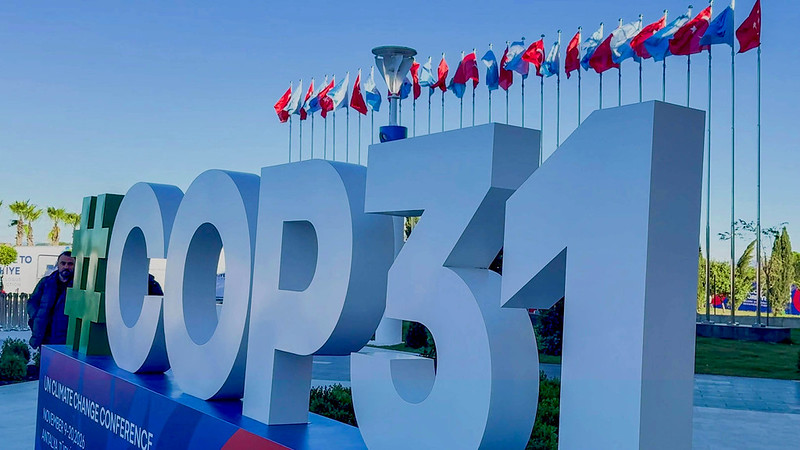
Speaking during a press conference at the 31st UN Climate Change Conference (COP31) in Türkiye, representatives of climate justice organisations criticised the continued reliance on private sector financing, carbon markets and loans, saying these mechanisms fail to address the scale of the climate crisis facing vulnerable countries.
The activists argued that climate finance should be treated as an obligation under international climate agreements rather than voluntary assistance or an investment opportunity.
Rachita Gupta, Global Coordinator of the Global Campaign for Climate Justice (DCJ), opened the discussion by highlighting the widening gap between financial pledges and actual disbursements. She noted that by July 31, 2026, the UN Loss and Damage Fund had received approximately $486 million against pledges of $823 million.
The shortfall, she said, illustrates the disconnect between governments’ climate commitments and the resources reaching communities already experiencing devastating climate impacts.
The activists also questioned global spending priorities, contrasting the limited resources available for climate action with worldwide military expenditure, which reached approximately $2.89 trillion in 2025.
Lady Nakpil of the Asian People’s Movement on Debt and Development argued that developed countries have a responsibility under the United Nations Framework Convention on Climate Change (UNFCCC) and the Paris Agreement to provide climate finance to developing nations.
She particularly challenged the growing use of the term mobilising finance, arguing that it allows wealthy countries to shift responsibility towards private investors instead of providing the public funding required under Article 9.1 of the Paris Agreement.
Article 9.1 establishes the obligation of developed countries to provide financial resources to assist developing countries with both mitigation and adaptation.
Nakpil called for alternative sources of public finance, including redirecting resources from fossil fuel subsidies and military expenditure towards climate action.
Historical emissions and the growing ecological debt
Ricardo Navarro of CESTA/Friends of the Earth El Salvador described the climate crisis as a question of ecological debt and global inequality.
He pointed to the disproportionate contribution of wealthy populations to greenhouse gas emissions, noting that the richest 10 per cent account for approximately half of global emissions, while the poorest contribute only about one per cent.
Navarro argued that the financial responsibility for addressing climate change should reflect this inequality.
He also highlighted the imbalance between climate finance requirements and existing financial flows. With global climate finance needs estimated at approximately $5 trillion annually, adaptation and loss and damage continue to receive insufficient attention compared with mitigation investments.
More than 70 per cent of climate finance is reportedly provided through loans rather than grants, increasing the debt burden of countries that are already struggling with the economic consequences of climate change.
Navarro cited figures indicating that developing countries pay approximately $8.8 trillion in debt servicing to wealthy countries and multilateral institutions, compared with just $39 billion received in grant-based public climate finance.
He argued that climate finance must address this structural inequality rather than create additional financial obligations for vulnerable nations.
Nepal’s floods expose the cost of delayed climate finance
The human consequences of inadequate and delayed climate financing were illustrated by Prayash Shadikari of People’s Movement for Climate Justice Nepal.
Shadikari presented the devastating impacts of the August Votekosi-Trishuli floods, which reportedly caused economic losses equivalent to four to five per cent of Nepal’s gross domestic product (GDP), killed nearly 1,500 people and left more than 5,000 missing.
He criticised the slow pace of international climate financing, citing a $36 million Green Climate Fund (GCF) grant for glacier-related flood risk reduction that took seven years to secure approval.
The lengthy approval process, he argued, demonstrates how bureaucratic procedures and complicated financing arrangements can undermine the ability of vulnerable countries to prepare for climate disasters.
He further observed that much of the international climate finance received by Nepal between 2016 and 2023 consisted of concessional loans rather than grants, increasing national debt instead of providing compensation for climate-related losses.
The activists warned that such arrangements risk turning climate finance into another source of economic vulnerability for countries least responsible for global warming.
Activists challenge carbon markets as a climate finance solution
The panel also questioned whether carbon markets and private sector-led financing can deliver equitable climate action.
Crash, another contributor to the discussion, argued that carbon markets often prioritise corporate profits over the rights and livelihoods of affected communities.
He warned that market-based carbon projects can result in Indigenous communities losing access to their ancestral lands as corporations pursue commercial interests.
Instead, activists called for fresh public funding that enables developing countries to access climate technologies, strengthen resilience and implement locally determined solutions without accumulating additional debt.
They also expressed concern about the influence of Global North-led multilateral development banks, warning that financing arrangements presented as climate reparations could impose austerity measures and further debt obligations on vulnerable countries.
COP31 negotiations must prioritise implementation
As COP31 negotiations continue, the activists are urging governments to move beyond technical discussions and establish predictable financing arrangements that respond to the immediate needs of vulnerable communities.
The DCJ is demanding at least $1 trillion annually by 2030 in new and additional public grants, with direct access mechanisms that enable affected communities to benefit from climate finance.
The campaign also calls for greater prioritisation of adaptation and loss and damage, arguing that existing commitments remain inadequate in addressing the scale of climate impacts.
The panel questioned whether the commitment to triple adaptation finance is meaningful without a clearly established baseline against which progress can be measured.
It further challenged negotiators to ensure that discussions on adaptation indicators translate into actual implementation supported by predictable and accessible funding.
For the activists, the central issue at COP31 is whether developed countries will acknowledge their historical responsibility and provide the resources needed to address the climate crisis.
Their message is that climate finance cannot be reduced to private investment opportunities, loans or voluntary contributions. It must recognise the unequal burden of climate change and deliver public resources as a matter of justice, accountability and international obligation.