


By Henry Neondo
Women’s rights advocates, climate activists and global leaders have urged governments to accelerate the implementation of the Belém Gender Action Plan, warning that its adoption will have little impact unless commitments are translated into concrete policies, adequate financing and protections for women and girls affected by climate change.
Speaking during a press conference at COP31, the advocates stressed that the nine-year Gender Action Plan (2026–2034), adopted at COP30 in Belém, Brazil, must now move beyond international commitments to deliver measurable improvements in the lives of women, girls and vulnerable communities.
Former Irish President and former United Nations High Commissioner for Human Rights, Mary Robinson, said the adoption of the plan was an important achievement, particularly amid growing opposition to gender equality and women’s rights in international negotiations.
She emphasised that the agreement should not be reopened for negotiations but implemented in full.
“The climate crisis is not gender neutral; it never has been,” Robinson said, describing climate change fundamentally as a human rights issue that disproportionately affects those who contribute least to the crisis and have the fewest resources to respond.
She noted that women and girls bear a disproportionate burden of climate impacts because of their responsibilities for water, food, fuel and care work. However, she also recognised women as critical experts in local knowledge, community resilience and climate response.
Robinson urged governments to provide the resources necessary for women’s meaningful participation in climate decision-making, improve their access to adaptation finance and strengthen their resilience to climate impacts.
Dr Melania Chiponda, an activist and Executive Director of Shine Collab, a global feminist network advancing women-led energy, climate and economic justice by resourcing grassroots movements said the success of the Belém Gender Action Plan would depend on whether governments recognise women, particularly those in grassroots and indigenous communities, as central actors in climate decision-making rather than merely as vulnerable groups requiring protection.
National assessments critical to implementation
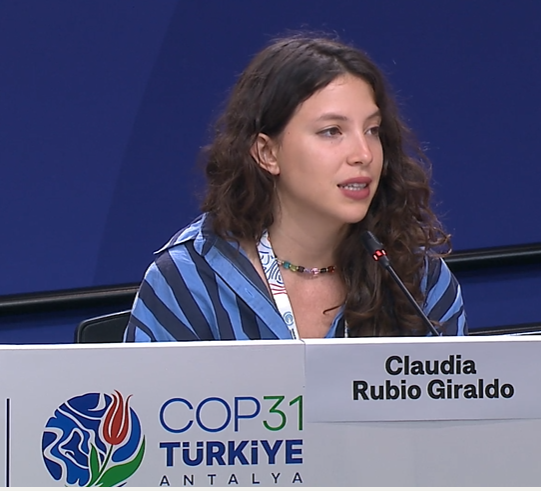
Claudia Giraldo, a Dominican-Colombian feminist, lawyer, and activist and one of the advocates involved in advancing the implementation framework, identified Deliverable 8.3.9 as an important early opportunity for governments to demonstrate commitment to the Gender Action Plan.
The deliverable invites parties and observers to submit findings from national assessments examining the intersections of gender and climate change, particularly in relation to health, violence against women and girls, and care work.
She explained that the assessments would help establish an evidence base for future interventions, financing decisions and follow-up activities under the nine-year framework, which contains 27 activities and 98 deliverables.
According to her, the assessments should go beyond documenting climate impacts to demonstrate how climate change affects health systems, intensifies gender-based violence during disasters and displacement, and increases unpaid care responsibilities.
Claudia called on governments to treat the assessments as more than a compliance exercise by bringing together ministries responsible for gender, health, environment and finance, while recognising civil society research and community-generated evidence as legitimate sources of knowledge.
She further urged governments to connect assessment findings to national climate strategies, project pipelines and financing mechanisms to ensure that evidence translates into policy change.
Protecting women environmental human rights defenders
The protection of women environmental human rights defenders also emerged as a central issue during the discussion.
Hira Amjad, Founder and Executive Director, DASTAK Foundation highlighted the experiences of women sustaining community resilience in climate-vulnerable areas, drawing attention to midwives in Upper Chitral, Pakistan, who support women through childbirth in a region exposed to glacier lake outburst floods.
She explained that climate disasters can destroy roads and isolate communities from essential healthcare, placing additional responsibilities on women who provide critical community support.
Hira said the Belém Gender Action Plan provides an opportunity to strengthen the safety, recognition and meaningful participation of women environmental human rights defenders, from grassroots movements to international climate negotiations.
She particularly highlighted Activity B4 of the plan, arguing that its success should be measured by whether defenders receive adequate protection, direct funding and genuine decision-making power.
She noted that women defenders continue to experience threats, violence and exclusion despite their contribution to climate action.
Through the Women and Gender Constituency, consultations are being organised at local, regional and global levels to ensure that defenders’ experiences and priorities inform implementation.
The consultations also seek to include women who cannot travel to international conferences, face language and digital barriers, or need to remain anonymous for security reasons.
Hira urged the UNFCCC and governments to ensure that contributions from these consultations inform practical safeguarding mechanisms and that defenders receive feedback on how their recommendations are used.
“Those who sustain our communities must also be sustained,” she said, emphasising that the safety, rest and well-being of women defenders should be recognised as essential to sustaining climate movements.
Brazil advances national implementation
Michelle Ferretti of Instituto Zidas in Brazil shared examples of national efforts to translate the Gender Action Plan into practical interventions.
She reported that Brazil had recently approved a national protocol on women in climate emergencies and was advancing a national strategy to mainstream gender into climate change policies.
The country’s Ministry of Women was also working with statistical institutions to develop a technical panel incorporating data disaggregated by gender, race and age.
However, Ferretti cautioned that these advances would not be sufficient without effective implementation at community level and adequate financial resources.
She called for coordinated action involving national parliaments, subnational governments and civil society, alongside financing arrangements that ensure implementation reaches communities.
Citing Brazilian President Luiz Inácio Lula da Silva, she emphasised that the climate crisis is also a crisis of injustice based on class, gender, race and inequalities among nations.
She further noted that the next COP on African soil presents a historic opportunity to mobilise additional resources for a continent facing significant debt challenges.
Ferretti argued that climate finance and implementation support must reach every continent, country and territory to ensure women and girls enjoy safety, health, well-being and dignity.
Growing backlash threatens gender equality gains
The discussion also highlighted growing resistance to gender equality commitments in international and national policy processes.
Mary Collins of the European Women’s Lobby warned that the backlash against women’s rights was accelerating, citing declining representation of women in decision-making, increasing online violence against women and funding cuts affecting women’s rights organisations.
She called for greater attention to gender-responsive budgeting to ensure that gender equality commitments are integrated into national and regional budgetary processes.
Robinson agreed that governments and civil society must remain vigilant against attempts to weaken previously agreed commitments, urging countries to move forward with implementation rather than reopen negotiations on established gender equality language.
Other panellists stressed the importance of subnational governments and civil society in sustaining progress, particularly where national political environments are becoming increasingly hostile to gender equality.
Claudia reiterated that the priority should be implementing the existing framework and its 98 deliverables rather than allowing negotiations to undermine previously secured commitments.
COP32 presents an opportunity to demonstrate progress
As countries look towards COP32 in Ethiopia, the panellists called for stronger collaboration between governments, civil society and grassroots movements to ensure that the Gender Action Plan delivers tangible results.
The discussion also highlighted the Pacific Gender and Climate Pact, launched by Pacific Island countries in June, as an example of regional leadership in translating the Belém agreement into collective action.
The initiative demonstrates how countries can work together to advance implementation and mobilise resources for gender-responsive climate action.
The panellists maintained that the journey towards COP32 should focus on strengthening national implementation structures, investing in health and care systems, protecting women environmental defenders and ensuring that climate finance reaches communities.
The overarching message was that adopting the Belém Gender Action Plan was only the beginning. Its success will ultimately depend on whether governments can translate international commitments into meaningful changes in the lives of women and girls.
As the climate crisis intensifies and opposition to gender equality persists, advocates insist that protecting previously secured rights requires sustained political commitment, adequate financing and accountability.
For Africa, which will host COP32, the opportunity will be to demonstrate how gender-responsive climate policies can advance climate justice, strengthen community resilience and ensure that women and marginalised communities are not left behind in the transition to a climate-resilient future.