




By Imali Ngusale
As Kenya’s lakes continue to swell beyond their historic boundaries, the crisis unfolding along their shores is not only environmental—it is deeply unjust. Communities that have contributed least to global emissions are paying the highest price, with women and children bearing the heaviest burden of climate-induced loss and damage.
From Marsabit to Turkana, Busia to Kisumu, rising waters have submerged homes, schools, markets, and grazing land, forcing families into displacement and deepening existing inequalities. In Marsabit County alone, floodwaters from Lake Turkana have engulfed public facilities, including El Moyo Primary School, disrupted livelihoods, and pushed already vulnerable households to the brink.
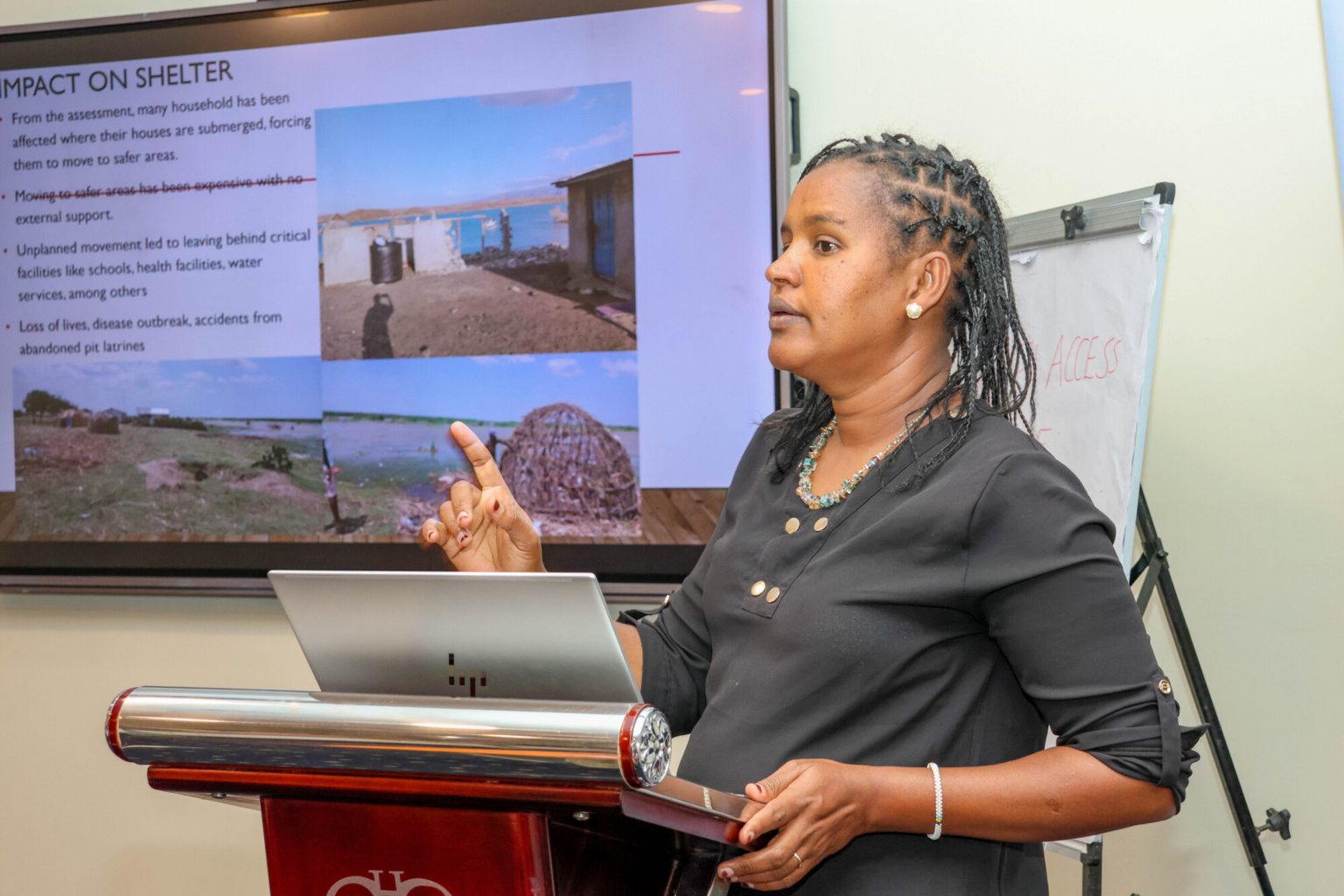
Against this backdrop, Kenya is stepping up efforts to confront loss and damage through a justice- and gender-informed lens. The Ministry of Environment, Climate Change, and Forestry recently convened a technical workshop in Nakuru County to strengthen national tools for documenting both economic and non-economic losses caused by prolonged hydrological changes. The meeting brought together county officials, researchers, disaster management agencies, development partners, and civil society actors to ensure that those most affected are no longer rendered invisible in climate accounting.
“Women are disproportionately impacted by climate change, and rising water levels have worsened their health, well-being, and livelihoods,” said Janet Ahatho, Director for Environment, Climate Change, and Natural Resource Management in Marsabit County. She noted that flooding has displaced families, reduced school attendance—particularly for girls—and increased unpaid care burdens, while exposing women and children to heightened protection and health risks.
For many communities, the losses extend far beyond damaged infrastructure. Professor Samuel Onywere of Kenyatta University emphasized that rising lake levels have triggered widespread social disruption. “In counties like Marsabit, advancing waters have displaced communities along nearly 200 kilometres,” he said, underscoring the scale of upheaval faced by pastoralist and fishing communities with limited alternatives.
Experts at the meeting called for stronger use of satellite technology and community-based data to trace shoreline changes, track displacement patterns, and ensure that climate impacts on women and marginalized groups are fully documented.
From a population and rights perspective, John Wafula, a programme specialist at the United Nations Population Fund (UNFPA), stressed that loss and damage cannot be reduced to financial figures alone. “These are not just numbers on a page,” he said. “We must document how climate change affects women, girls, and other vulnerable groups so responses are inclusive, rights-based, and grounded in evidence.”
Francis Kaloi, a researcher at the Kenya Institute for Public Policy Research and Analysis (KIPPRA), echoed this view, warning that conventional economic assessments often overlook the “invisible wounds” of climate change—lost dignity, interrupted education, psychosocial trauma, and eroded social networks. He noted that women, girls, and persons living with disabilities continue to absorb the heaviest shocks, despite having the least access to decision-making and resources.
The workshop was led by the Climate Change Directorate in collaboration with UNDP Kenya and focused on operationalising climate hotspot mapping under the Barbados Implementation Modalities (BIM), aligned with Article 8 of the Paris Agreement. The framework is intended to help countries systematically assess climate impacts and access international financing for loss and damage.
Preliminary findings shared during the discussions estimate that rising lake levels have already caused approximately USD 60 million in cumulative losses in Kenya—costs that reflect damaged infrastructure, lost livelihoods, and degraded ecosystems. Yet participants cautioned that such figures still fall short of capturing the full human cost, particularly for women whose labour, safety, and well-being remain undervalued.
As global politics threaten to stall progress on loss and damage financing, Kenya’s efforts highlight a growing demand from the Global South: climate action that is not only scientific, but just; not only funded, but fair. For communities living at the water’s edge, recognition, accountability, and gender-responsive support are no longer optional—they are a matter of survival.