



By Edwin Austin
The Intergovernmental Authority on Development (IGAD) has reinforced its commitment to peace and stability in the Republic of Sudan by emphasizing the importance of the country’s reintegration into the regional bloc.
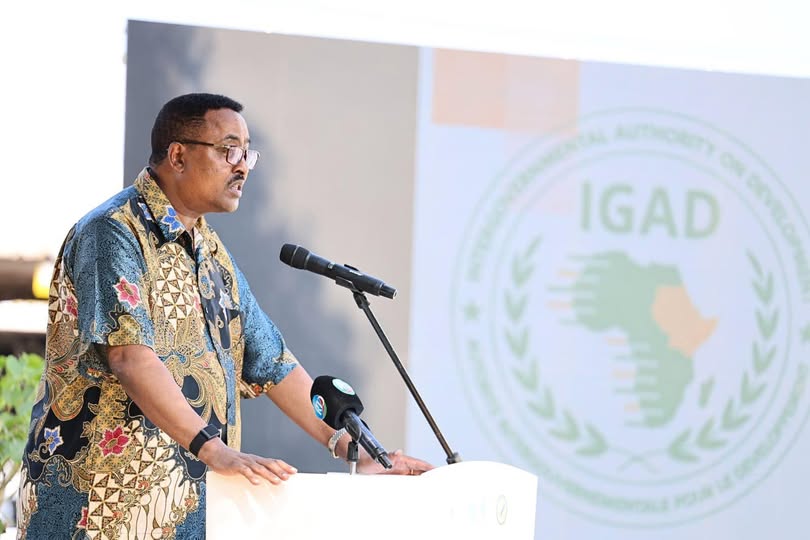
During a high-level meeting held on the 29th of January 2025, IGAD Executive Secretary Dr. Workneh Gebeyehu engaged in consultations with Sudan’s Prime Minister, Dr. Kamil El-Tayeb Idris, underscoring IGAD’s readiness to welcome Sudan back into its institutional fold.
The cornerstone of the meeting, and IGAD’s broader message, was a clear call for Sudan to return to the bloc and condemning the recent violations committed by the Rapid Support Forces, a paramilitary group that has played a controversial role in Sudan’s ongoing security challenges.
IGAD also expressed strong support for Sudan’s National Initiative aimed at restoring peace and stability, highlighting the importance of coordinated efforts inside and outside Sudan to address the country’s complex security and political dynamics.
Historical Context and Evolution
IGAD has historically played a vital role in conflict resolution, peacekeeping, and fostering economic development in member states.
Sudan’s relationship with IGAD has seen fluctuations over the years, impacted by the country’s internal conflicts and political upheavals.
Sudan joined IGAD as a founding member of its predecessor, the Intergovernmental Authority on Drought and Development (IGADD), which was established in 1986.
IGADD initially focused on development and environmental control and included Djibouti, Ethiopia, Somalia, Sudan, Uganda, and Kenya as founding members.
The decades-long civil wars, which led to the independence of South Sudan in 2011, had considerable regional repercussions. Sudan remained a member of IGAD continuously since 1986 but suspended its participation in 2024. It indicated a cessation of active involvement rather than a formal withdrawal.
More recently, Sudan has grappled with internal fractures compounded by military factions such as the Rapid Support Forces, which have been implicated in violence and destabilization. This has affected Sudan’s full participation in regional processes, limiting collaborative progress and regional cooperation.
Suffice it to say, IGAD’s renewed call for Sudan’s reintegration signals a desire to strengthen collective action toward sustainable peace in the Horn of Africa, and its emphasis on Sudan’s sovereignty and national institutions underscores its approach of supporting internal reconciliation and institution-building as pillars for lasting stability.
By inviting Sudan back into its framework, IGAD aims to enhance collaboration on security, economic development, and political reforms that address the root causes of conflict.
This approach is crucial not only for Sudan’s future but for the broader stability of the Horn of Africa region, which faces intertwined challenges of conflict, displacement, and economic hardship.
As Sudan steps forward with its National Initiative, as the Executive Secretary noted, IGAD stands ready to support and guide its reintegration, hoping that such cooperation will contribute to ending instability and fostering a peaceful, united Sudan.