




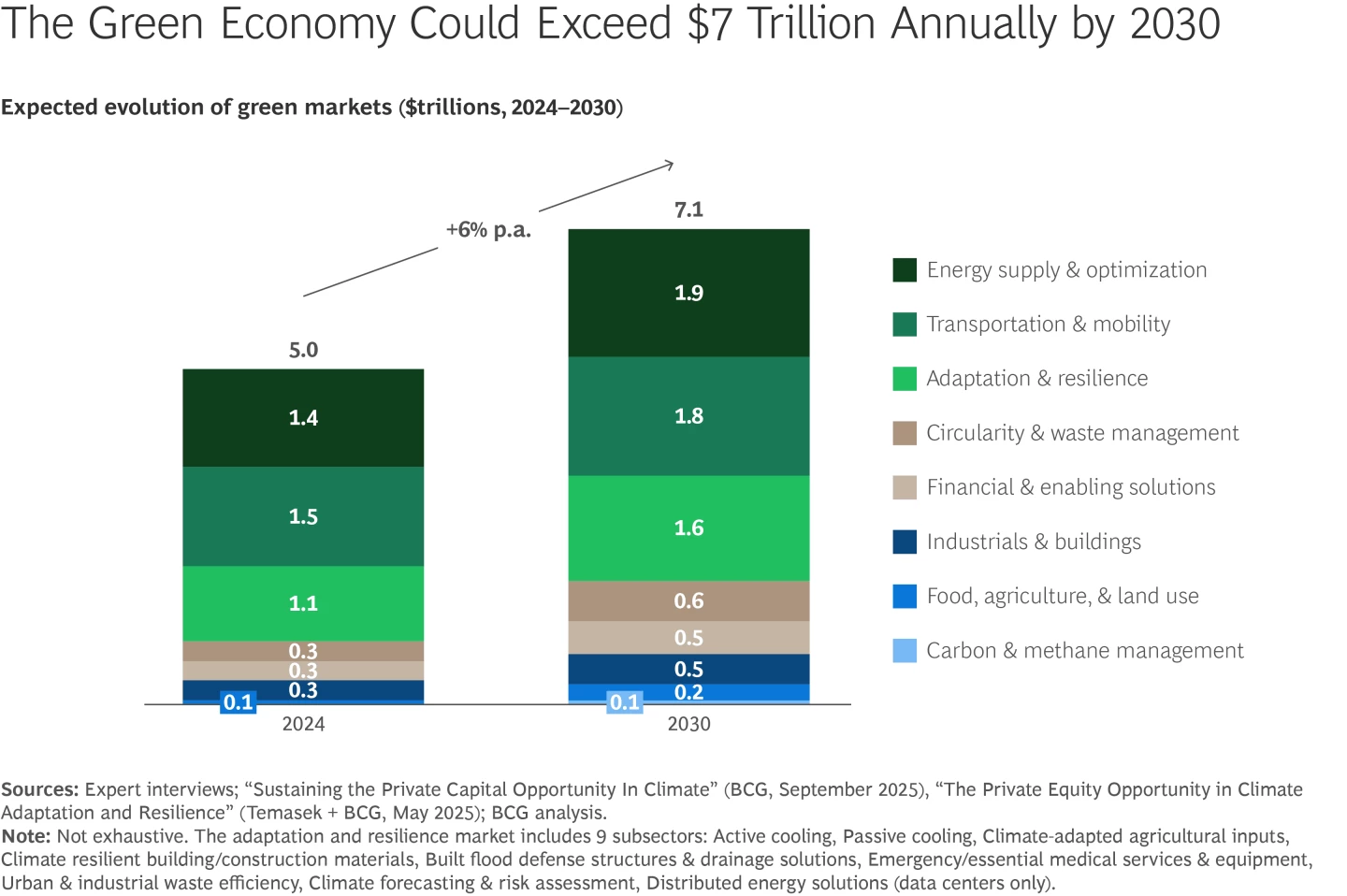
A landmark report released today by the World Economic Forum’s Alliance of CEO Climate Leaders and Boston Consulting Group (BCG) reveals that the global green economy has already exceeded $5 trillion and is on track to surpass $7 trillion by 2030. Over the past decade, it has become the second-fastest-growing sector in the world—outpaced only by technology.
The report, Already a Multi-Trillion-Dollar Market: CEO Guide to Growth in the Green Economy, shows that companies at the forefront of low-carbon and climate-resilient solutions are consistently outperforming the market, attracting cheaper capital, and commanding higher valuations.
Africa is emerging as a critical player in the global clean energy transition. Solar panel imports across 20 African countries surged by 60% in the past year, reaching a record 15 GW—the continent’s first-ever large-scale solar rollout.
Twenty-five countries imported at least 100 MW of solar modules compared to just 15 the year before, signaling a continent-wide shift toward clean, distributed energy.
Renewable capacity across Africa is expected to grow ~10% annually, driven by distributed solar, utility-scale projects, and sharply falling technology costs. In markets like Nigeria, switching from diesel to solar now pays for itself in under six months—accelerating adoption across homes, businesses, and industries.
Despite macroeconomic pressures, regulatory delays, and polarized public opinion, the green economy is expanding with extraordinary resilience. Record capital is flowing into clean energy, sustainable mobility, resilient infrastructure, and circular solutions—making green growth a strategic driver of long-term competitiveness.
Adaptation solutions are also rising sharply, now attracting over $1.1 trillion annually for innovations such as heat-resilient cooling, new construction materials, and advanced flood protection.
“With $2 trillion in expected growth over the next five years, opportunities are abundant. Our CEO guidebook shows leaders where to start,” said Patrick Herhold, Managing Director and Senior Partner, BCG.
With these declines, 55% of global emissions can now be abated with already cost-competitive technologies, and another 20% can be reduced at modest cost premiums.
Across the top 20 African solar importers, solar adoption is rapidly reducing reliance on expensive diesel. Yet the report notes that fossil fuel imports still outweigh solar investments by 30 to 100 times, signalling massive untapped opportunity for clean power to reshape trade balances and energy security.
China continues to redefine global leadership in clean technology. In 2024, it invested $659 billion in clean energy—over 50% more than any other country. It leads globally in solar and wind deployment, battery manufacturing, and green tech patents, reshaping global supply chains and accelerating innovation cycles.
Morocco’s OCP Group exemplifies how African firms are blending mature and emerging technologies—scaling renewables, seawater desalination, and digital mining, while pioneering investments in green hydrogen, carbon capture, and circularity.
With distributed solar booming and utility-scale projects rising, Africa is well-positioned to strengthen its global competitiveness. With the right policy frameworks and grid investments, the continent could become a major force in clean energy and climate resilience.
“The green transition remains one of the largest growth engines of our time—driving jobs, innovation, resilience, and shared prosperity,” said Pim Valdre, Head of Climate and Nature Economy, World Economic Forum.