


By Henry Neondo
Faith organisations call for increased adaptation finance, a just transition away from fossil fuels and greater protection for vulnerable communities
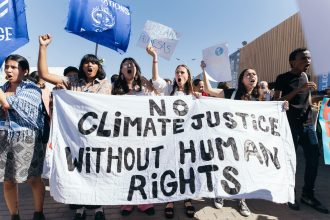
Faith leaders and climate justice advocates have called on governments attending COP31 in Antalya, Türkiye, to move beyond climate commitments and deliver concrete action, warning that vulnerable communities are already bearing the devastating consequences of global warming.
Speaking at a joint press conference organised by the Lutheran World Federation, Franciscans International and the World Council of Churches, representatives of faith-based organisations said the climate crisis was increasingly threatening livelihoods, homes, food security and human dignity, particularly among communities that have contributed least to global greenhouse gas emissions.
Budi Chayono of Franciscans International said climate change was no longer a distant environmental threat but a daily reality for millions of people.
“Our message at COP31 is clear: the time for promises without implementation is over. We have to act now,” he said.
The faith organisations called on governments to defend the Paris Agreement, keep the 1.5°C temperature limit within reach and accelerate the implementation of their Nationally Determined Contributions (NDCs).
Simon Harder of the Lutheran World Federation warned that weakening climate commitments and continued dependence on fossil fuels were undermining global efforts to address the crisis.
He cited projections indicating that global emissions would need to fall by 69 per cent by 2040, compared with 2025 levels, to return global warming to 1.5°C or below by the end of the century. Under existing policies and actions, the world is instead heading towards approximately 2.6°C of warming.
Harder urged governments to direct new energy investments towards renewable energy rather than expanding fossil fuel infrastructure.
He also stressed that transitioning from one energy source to another would not, by itself, guarantee a just transition. Indigenous peoples, women and local communities must have meaningful participation in shaping energy and climate policies.
Adaptation finance remains inadequate
A major concern raised during the press conference was the gap between international climate finance commitments and the resources actually reaching vulnerable countries.
Climate finance advocates welcomed the agreement reached at COP30 in Brazil to triple adaptation finance by 2035 but warned that governments had yet to establish a clear baseline, tracking methodology and delivery pathway for the commitment.
One of the speakers highlighted that even an annual adaptation finance allocation of US$120 billion would remain substantially below estimated global needs, which could reach US$300 billion annually by 2035.
The speaker called for adaptation support to be delivered primarily through grants and highly concessional financing, arguing that climate-vulnerable countries should not accumulate additional debt to protect their populations against a crisis they did little to create.
The scale of the challenge was also evident in the funding gap facing the Fund for Responding to Loss and Damage. According to figures presented at the press conference, the fund received 172 funding requests worth approximately US$2.8 billion against only US$342 million available during its first funding window.
The organisations urged countries that had pledged contributions to fulfil their commitments and called on others to contribute urgently.
Palestine highlights climate justice in conflict zones
The conference also drew attention to the intersection of climate vulnerability, armed conflict and environmental destruction, particularly in Palestine.
Simon Watt, Executive Director of the Environmental Education Centre of the Evangelical Lutheran Church in Jordan and the Holy Land, said climate justice in conflict-affected territories could not be separated from human rights, access to natural resources and political self-determination.
He described how restrictions on access to land and water, destruction of agricultural infrastructure and displacement were undermining Palestinian communities’ ability to adapt to climate change.
Watt also raised concerns about the destruction of approximately 13,000 olive trees during the olive harvest season, describing the trees as an important part of Palestinian cultural heritage, livelihoods and intergenerational sustainability.
He called for international accountability, the restoration of damaged agricultural land and water systems, and compensation mechanisms to rebuild renewable energy infrastructure and ecosystems, particularly in Gaza.
Pacific communities demand an end to fossil fuel expansion
Representing the Uniting Church in Australia, Reverend Faimata Hafeya Hilau called on Australia to demonstrate climate leadership by acting as a responsible neighbour to Pacific Island communities facing rising sea levels, extreme heat, bushfires and flooding.
She criticised Australia’s continued role as a major fossil fuel exporter despite its capacity and responsibility to support a global transition away from coal and gas.
Hilau challenged the Australian government to stop approving new coal and gas projects, increase its contribution to climate finance, particularly the Pacific Resilience Facility, and develop a national roadmap for a fair transition away from fossil fuels.
“Listen to the Pacific. Stop expanding and exporting coal and gas, pay our fair share on climate finance, and show the world that Australia has a credible plan to transition out of fossil fuel,” she said.
Faith communities demand accountability
Regina Banks, Director of the Lutheran Public Policy Office in California, United States, defended the participation of faith organisations in international climate negotiations, saying churches were directly involved in supporting communities affected by floods, wildfires and other climate-related disasters.
She argued that faith communities had a responsibility not only to provide humanitarian assistance but also to challenge the political and economic decisions driving climate injustice.
Banks emphasised that women, girls, Indigenous peoples, minority communities and the poor were disproportionately affected by climate change.
She said climate finance, adaptation and loss and damage should be treated as matters of justice rather than charity, adding that the responsibility of faith organisations to advocate for vulnerable communities would continue beyond individual climate conferences and political administrations.
The press conference concluded with four major demands to COP31 governments: defend the Paris Agreement and the 1.5°C target; accelerate a just transition away from fossil fuels; provide adequate, accessible and predictable climate finance, particularly for adaptation and loss and damage; and guarantee meaningful participation by women, Indigenous peoples, young people and displaced communities.
The faith leaders said the success of COP31 should ultimately be measured not by new declarations but by whether governments translate existing commitments into resources, policies and actions that protect the people most exposed to the climate crisis.