



Hundreds of women environmental defenders, community organisations, and their allies will mobilise across the continent and beyond to mark the inaugural African Women’s Climate Justice Day, under the theme: “Our Lands, Our Voices: African Women United for Reparations and Climate Justice!”
This landmark Day of Action emerges at a critical moment. As the world faces escalating climate catastrophes, wars and resource-driven conflicts, deepening inequality, and widespread ecological destruction, African women – who are among the most impacted – are also leading some of the most radical solutions. Their voices, leadership, and resistance are more vital than ever in the global fight for climate justice and reparations.
“This day is very important because it builds on our efforts to promote climate justice for rural women. It is an opportunity for us to make our voices heard and to highlight that climate justice is a pressing issue and that climate injustice continues to claim victims, particularly African women. It is also a chance to ensure that reparations are made for the damage caused.” — Odette Toe, Burkina Faso
Amplifying Voices on the Frontline
The main aim of African Women’s Climate Justice Day is to amplify the voices, struggles, and resistance of African women on the frontlines of the climate crisis, particularly those impacted by extractivist and exploitative development models. Through awareness-raising efforts and ecofeminist popular education, symbolic actions and poster-making, community dialogues and artivism, women will come together to denounce the global capitalist system and spotlight the demands of grassroots African women’s movements for climate justice and reparations.
Marked by solidarity and community mobilisation, the day is a decisive turning point: African women are turning climate inaction into a demand for climate reparations. By uniting their voices, they are demanding restorative justice that goes beyond mere humanitarian aid; they are calling for the payment of a legitimate climate debt owed by the countries responsible for the climate crisis—and concrete measures to repair the damage they and their communities have suffered. Their demands establish a link between environmental preservation and economic and social justice.
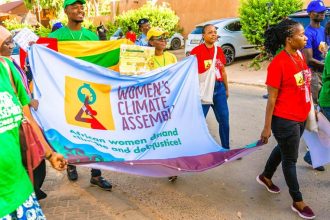
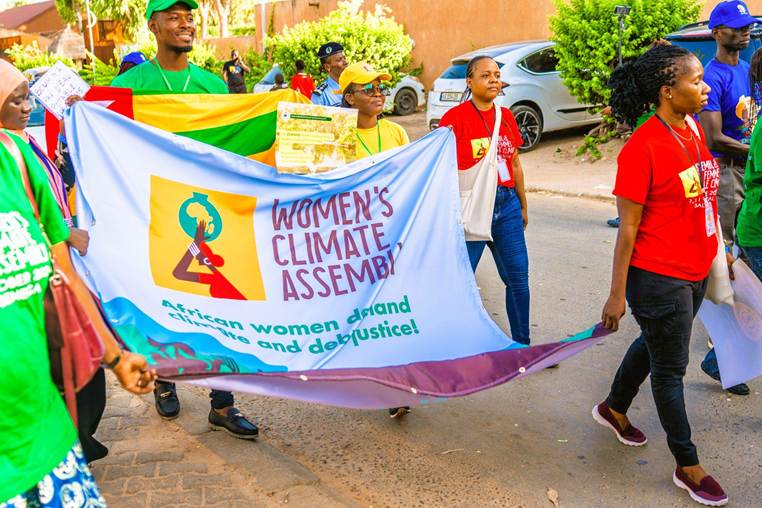
Since 2022, women from across Central and West Africa have gathered annually through the Women’s Climate Assembly (WCA) – a growing Pan African, grassroots-led platform that brings together over 120 activists, ecofeminist leaders, and community organisers. The WCA provides a powerful space to collectively analyse the intersecting crises affecting their communities and to develop strategies of resistance rooted in climate justice, food sovereignty, and the Right to Say NO to destructive extractivist and mega-development projects that displace communities, erode ancestral ways of life and destroy ecological futures.
“Through our march and this assembly, we have left our fingerprints, and it is clear what we want for our environment, our climate, our ecosystem, our livelihoods. During the COPs, we have seen how the agendas of the donor countries dominate. You cannot come and steal African resources, and at the same time help us to get climate justice.” — Khady Faye, Senegal
The Assembly is part of a broader movement under the African People’s Counter-COP, led by the African Climate Justice Collective (ACJC). This alternative space is a direct response to the failure of official global climate summits, which continue to ignore the particular impacts on African women’s lives and livelihoods. By centering this movement, we ensure that the struggles and solutions of frontline communities across Africa and the Global South are no longer marginalised but placed at the heart of the global agenda.
A Day of Powerful Resistance and Reclamation
The declaration of April 15 as African Women’s Climate Justice Day follows a resolution made by the WCA Steering Committee in February 2026 in Monrovia, building on earlier calls from the 2024 Assembly in Saly, Senegal. This day represents a bold act of resistance and defiance against a global system that prioritises profit for elites and greedy corporations at the expense of people and planet—and a reclamation of African women’s voices, agency, and narratives.
“Guided by the spirit of their ancestors, African women raise freedom like a song, transform resistance into creative strength, and sow the hope of a just, equitable, and sustainable future.” — Sakinatou Ouédraogo, Burkina Faso
Together, African women rise to protect their lands, amplify their voices, and demand the reparations and climate justice they and our planet deserve.