


By Pauline Ongaji
For many cancer patients, leaving hospital after treatment is not the end of their medical ordeal. It is the beginning of another difficult phase of managing the side effects of treatment, coping with uncertainty and waiting for the next appointment, sometimes hundreds of kilometres away.
Chemotherapy may be over for the day, but its effects can linger. Patients return home with nausea, vomiting, pain, fatigue and other complications. Some experience symptoms they are unsure how to interpret, while others struggle with changes to their bodies that they may find difficult or embarrassing to discuss with healthcare workers.
For those living far from specialised cancer facilities, getting medical attention between scheduled appointments can be especially challenging. An unexpected complication may mean arranging transport, finding money for the journey and travelling long distances back to hospital.
In Uganda, doctors at the Uganda Cancer Institute (UCI) are exploring whether a simple mobile phone call can help bridge this gap in cancer care.
Through an automated telephone monitoring system, patients receive calls at home and respond to questions about their health and treatment-related symptoms. Their answers are collected and assessed against predetermined thresholds, allowing healthcare workers to identify those who may need medical attention before their next scheduled visit.
The idea is to extend the reach of cancer services beyond hospital walls, ensuring that patients do not disappear from the health system once they return home.
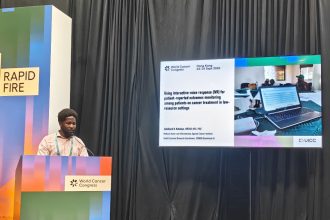
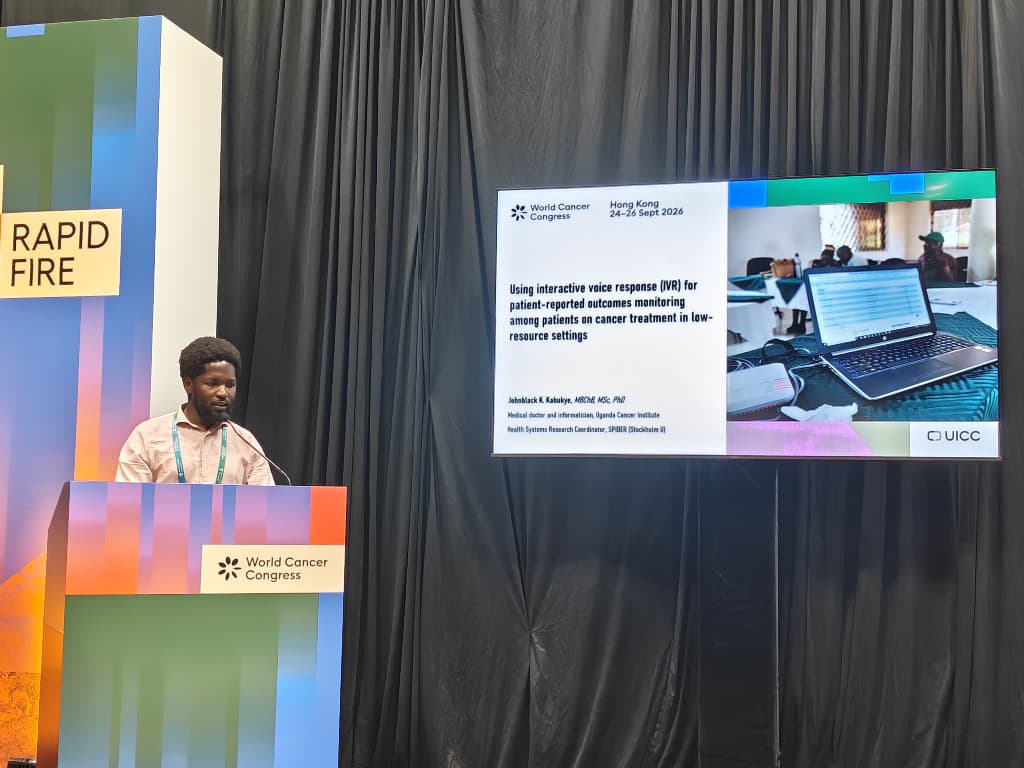
Dr. Johnblack Kabukye, who is involved in developing the system, says following up with patients after treatment has long been a challenge for cancer centres operating with limited human resources.
“Once patients are at home, there is no easy way to follow up on them, yet they develop toxicity in between visits,” he explains.
While nurses and social workers can make follow-up calls, doing so manually is labour-intensive and often impractical for cancer centres in Uganda and other resource-constrained settings.
The problem, he says, is not only the difficulty of reaching patients. It is also that some symptoms may never make it into conversations between patients and their doctors.
Patients may feel embarrassed discussing sexual dysfunction or changes in body image following breast removal or other surgical procedures. Other concerns, such as hair loss and changes in skin colour, may receive less attention during consultations focused on more serious clinical complications.
“An automated system using standardised questionnaires can create an opportunity to capture these concerns more consistently.”
It also offers patients an avenue to report symptoms they might otherwise overlook or hesitate to discuss during hospital visits.
The pilot at UCI has provided an initial indication that automated monitoring can work in a setting where healthcare workers are already stretched.
Involving 100 patients, the pilot recorded 18 occasions when patients were called back to hospital for readmission before their scheduled return dates because of concerns identified through the monitoring system.
“Two of the patients died during their readmission., and although the findings do not establish whether earlier intervention changed their outcomes, they illustrate the seriousness of complications that can develop between hospital appointments,”he adds.
For Dr. Kabukye, one of the important achievements of the pilot was demonstrating that patients could be reached and useful information collected through automated calls.
“Calls were answered and useful data collected. This is the first step before we push for scale-up and national implementation,” he says.
The exercise also generated lessons about how such a system should be implemented.
“Patients need to be trained when they enrol, while the timing of calls, wording of questions, language used and available response options all influence whether the system works effectively.”
Even unanswered calls may carry important information. Dr. Kabukye says failure to complete a call could indicate that a patient is unwell and should not automatically be dismissed.
There are also potential data-quality challenges. “A relative may answer the phone on behalf of a patient, providing information that does not accurately reflect the patient’s condition. Random manual surveys and other quality-control measures are therefore necessary.”
But identifying a patient who may be deteriorating is only one part of the equation.
For the technology to make a significant difference, an alert must translate into action. “A healthcare worker must review the information, contact the patient and determine whether further assessment or treatment is necessary.”
For patients living outside Kampala, where specialised cancer services are concentrated, returning to hospital is not always straightforward.
An instruction to come back for medical review can mean spending money they may not have, arranging transport and travelling for hours while already unwell.
Dr. Kabukye acknowledges that the telephone monitoring system cannot resolve these geographical and financial barriers.
“It is not a solution to all the challenges in cancer care,” he says.
Instead, its purpose is to help healthcare providers understand how patients are doing between visits and determine which symptoms require attention.
In some instances, the technology could actually save patients unnecessary journeys.
A patient experiencing hair loss, for example, may worry that the symptom signals a serious complication and travel back to the cancer centre for reassurance. Through the monitoring system, healthcare workers can explain that hair loss is an expected effect of treatment and that the patient does not necessarily need to return to hospital.
Where symptoms exceed a predetermined threshold, a healthcare provider is notified and can manually contact the patient. Depending on the nature of the symptoms, the patient may be advised to seek supportive treatment at a nearby health facility rather than travel all the way to the cancer centre.
For Dr. Kabukye, people without access to a phone remain outside the system and must instead be assessed during their routine clinic visits.
However, he argues that the use of basic mobile phones makes the intervention relatively accessible.
In this case, patients do not need smartphones, mobile internet or specialised applications. The system initiates the calls, meaning patients do not incur the cost of making them.
Language is another consideration. Uganda is linguistically diverse, and questions about pain, nausea, bleeding and other complications must be understood correctly for patients to provide meaningful responses.
For now, the monitoring system operates in English and Luganda. Dr. Kabukye says expanding it to other languages is possible but requires additional funding.
The team has previously translated similar cancer-awareness content into seven languages, including Kiswahili.
Although the system automates the process of contacting patients and collecting information, decisions about their care remain with healthcare workers.
Patients are asked to rate their symptoms on a scale of one to four. Currently, reports of symptoms rated three or four trigger an alert to a healthcare worker.
The team is still investigating whether this is the most appropriate threshold.
Lowering it could help identify more patients who need attention, but it could also generate too many alerts, overwhelming healthcare workers. Raising it could reduce the number of alerts but risk missing patients whose symptoms require intervention.
The team intends to refine the thresholds as more data become available.
Dr. Kabukye says expansion would require funding for translations, the development of questionnaires for different cancers and further research to optimise the symptom-alert thresholds.
He believes governments should ideally finance the intervention because monitoring patients between appointments is part of delivering effective healthcare. “Development agencies and grant-making organisations could also support implementation, while telecommunications companies could contribute by covering call costs through their corporate social responsibility programmes,” he adds.