





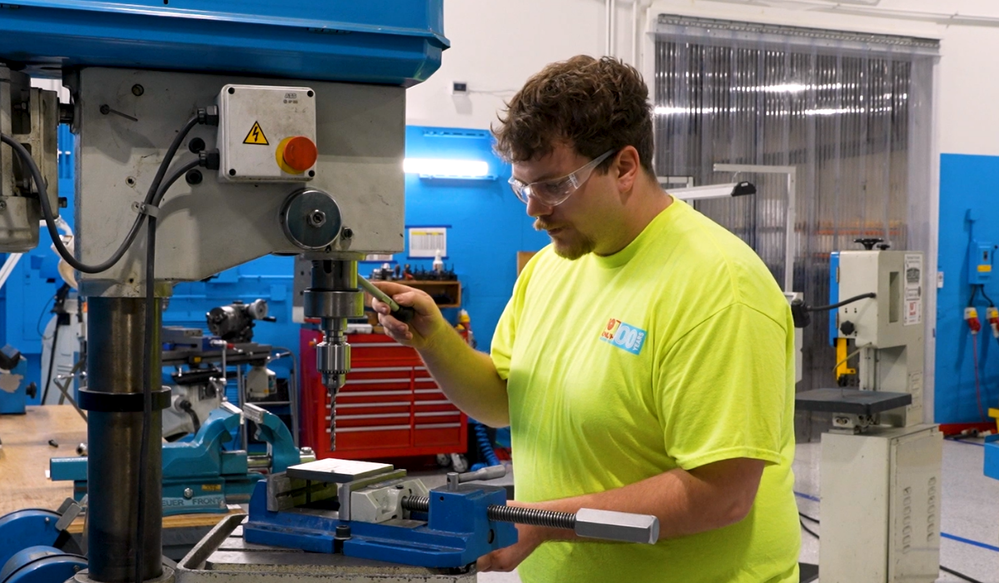
As South Africa’s Class of 2025 receives their results and universities and colleges prepare to welcome a new intake of students, an accelerating shortage of skilled tradespeople is emerging as one of the most pressing challenges facing the manufacturing sector. Behind the scenes of everyday life, a critical skills gap is widening – one that threatens productivity, innovation, and long-term industrial sustainability.
Why there is a growing skills gap
It has become clear that fewer young people are pursuing technical careers in machining, toolmaking, and mechanical engineering. For decades, there has been a strong emphasis on university degrees as the primary path to success, often at the expense of vocational and technical training, leaving skilled trades overlooked and undervalued despite being vital to industry and innovation.
Machining has evolved into an advanced, technology-driven profession. Modern operations integrate automation, CNC technology, digital systems, and precision engineering, but many learners never see this firsthand. The lack of exposure to technical careers, coupled with cuts to technical subjects in schools, has tightened the pipeline of emerging talent.
Economic pressures also play a significant role. For families facing financial constraints, pursuing a trade can seem less attainable than a free or subsidized university degree. With university education often viewed as the safer path to stable employment and long-term income, many young people are further discouraged from considering technical careers.
“Machining is not a trade of the past – it’s a career of the future,” says Ruan Cowley, Managing Director of Knuth Machine Tools South Africa. “These are high-tech, innovation-driven roles that form the backbone of modern manufacturing. We need to show young people the opportunities these careers offer, and make technical training more accessible, so South Africa can close the skills gap and secure its industrial future.”
Why the skills gap is a serious problem
As experienced machinists, toolmakers, and engineers retire, too few qualified professionals are entering the workforce to replace them. This creates a growing skills gap that directly affects the manufacturing sector. Companies struggle to meet modern manufacturing demands, while the lack of skilled expertise limits their ability to adopt new technologies and remain competitive in a rapidly evolving global market.
In the long term, the impact is far-reaching. The skills shortage doesn’t merely slow production, it restricts progress, undermines economic growth, and weakens industrial resilience. South Africa is no exception. If the skills pipeline is not strengthened, the country risks losing manufacturing capacity, competitiveness, and opportunities for sustainable job creation.
“At Knuth Machine Tools, having supported customers of all sizes across every sector of the metalworking industry, we understand that the strength of manufacturing has always rested on its people – the craftspeople, operators, and engineers who bring machines to life,” says Cowley.
Looking at the bigger picture
Society relies on machining far more than most people realise. Nearly everything we depend on – cars, aircraft, medical devices, smartphones, and even the infrastructure that delivers electricity and clean water – exists because of machining. Every component, no matter how small, must be manufactured with precision somewhere along the value chain.
Machining enables consistency, accuracy, and scalability, allowing industries to produce reliable components at volumes and quality levels modern life demands. Without it, products would be more expensive, less reliable, or simply impossible to produce.
“Although largely unseen in daily life, machining is the quiet force that keeps economies moving,” says Cowley. “It drives technological advancement, enables new materials and designs, and makes complex engineering solutions possible. Machining is not a supporting industry – it is a foundational one.”
“As a leader in the industry, Knuth Machine Tools is focused on addressing the skills shortage. We have exciting plans underway this year and beyond to support the next generation of skilled tradespeople – stay tuned for what’s ahead,” says Cowley.