





By Lenah Bosibori
Hazardous waste is no longer a distant environmental concern. Across Africa, it has become part of everyday life flowing through polluted rivers, contaminating lakes and public swimming pools, and seeping into farms, informal settlements and industrial zones. Yet despite its growing impact on public health, toxic waste remains poorly understood, weakly regulated and rarely reported.
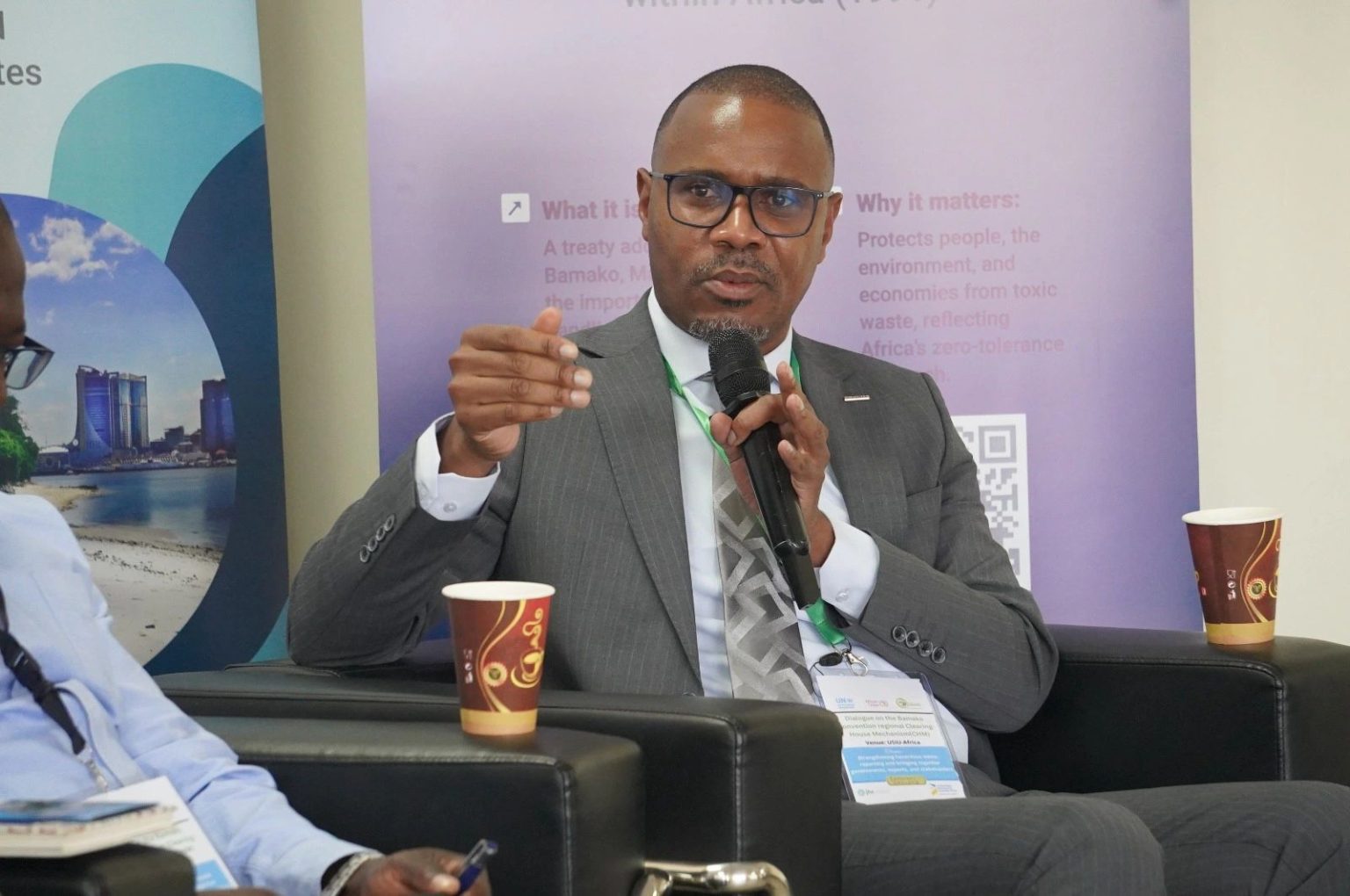
This concern took centre stage on Wednesday at the United States International University–Africa (USIU-Africa) during Africa’s first dialogue on the Bamako Convention’s Regional Clearing-House Mechanism (CHM), held under the theme Strengthening hazardous waste reporting and coordination.
Speaking during the discussion, Kaside Omondi, a platform developer with the Bamako Convention’s Regional Clearing-House Mechanism (RCHM), said waste dumped into the Nairobi River continues its journey long after it leaves the city.
“What happens to waste once it leaves Nairobi? We assume it disappears, but it doesn’t,” Omondi said. “Waste from homes, businesses and industries is carried downstream, collecting pollutants before eventually emptying into the Indian Ocean.”
The forum brought together government officials, environmental experts, academics, journalists and students, all warning that hazardous waste released into inland waterways does not simply disappear but travels, crossing borders and threatening communities far beyond its source
He further warned that pollution entering rivers does not stop at national boundaries. “Waste flowing into Lake Victoria, for example, affects neighboring countries such as Uganda and Tanzania, while pollutants that reach the ocean spread widely, threatening coastal ecosystems and communities across the region,” said Omondi.
At the centre of the discussions was the Bamako Convention, Africa’s strongest legal response to the dumping of hazardous and radioactive waste. Adopted in 1991, the treaty bans the import of toxic waste into Africa and emphasizes preventing pollution at the source before it enters inland waterways.
However, participants noted that weak enforcement and limited public awareness continue to undermine its effectiveness.
“Environmental journalism is a major gap in our newsrooms,” said Prof Ruth Owino, an assistant professor of corporate communication. “Only one university in the region offers specialized training in environmental journalism. That should worry us.”
Echoing this concern, Prof Geoffrey Serede Sikolia, Dean of the School of Communication, Cinematic and Creative Arts at USIU-Africa, warned that environmental reporting remains one of East Africa’s weakest beats.
“Without proper training, journalists struggle to interpret scientific data, environmental treaties and health studies,” he said. “As a result, toxic waste stories are often ignored or oversimplified.”
He pointed to electronic waste as a striking example. As wealthier countries upgrade technology, discarded devices filled with toxic materials are shipped to Africa. “We became the end of the global chain,” he said. “Once waste reaches Africa, it goes no further.”
The challenge, he added, is compounded by changing media consumption habits, as audiences increasingly turn to digital platforms and social media for information. “People already know what will be on the 9pm news,” he said. “They want information instantly.”
This shift, he argued, demands that journalists master digital tools, data and multimedia storytelling without sacrificing accuracy or depth. “Journalists are now brands,” he said. “The question is: what audience do you reach, and what truth do you tell them?”
Students at the forum brought the issue closer to everyday experience. Nathan Balua, an international relations student at USIU-Africa and a professional swimmer, spoke about the impact of pollution on water bodies used for recreation.
“Harmful chemicals from industries, farms and fuel spills end up in rivers, lakes and even public swimming pools,” he said. “When chemicals mix in water, they create serious health risks.”
Balua explained that hazardous waste comes in many forms—toxic, flammable, reactive and infectious materials. Factories discharge solvents, acids and metal waste into rivers, often untreated. Agricultural pesticides and herbicides slowly poison soil and waterways, while oil spills contaminate land and water.
Mining is another major contributor. Acidic runoff from mines carries heavy metals such as mercury, lead and cadmium into rivers and groundwater.
“These substances accumulate in the body over time, causing birth defects, organ damage and chronic illnesses,” Balua said. “You may not feel the effects immediately, but the damage lasts for years.”
Everyday spaces are also affected. Public swimming pools rely on chlorine to keep water clean, but when chlorine reacts with urine, it forms harmful gases that irritate the eyes, skin and lungs especially in crowded or poorly ventilated pools.
Rivers and lakes, relied upon for drinking water, fishing and bathing, are increasingly polluted by sewage, fuel spills and plastic waste. Over time, plastics break down into microplastics—tiny particles now found in human blood, urine and other bodily fluids.
Studies cited at the forum show troubling trends. Since the 1960s, testosterone levels in men have steadily declined, a change, researchers partly link to exposure to chemicals and microplastics, raising concerns about fertility and long-term reproductive health.
Participants also highlighted estrogen-like chemicals found in perfumes, cosmetics, detergents, treated clothing and contraceptives. These substances disrupt hormones and can suppress testosterone levels in men, contributing to infertility. Some are also released into water systems through industrial waste.
The health risks linked to hazardous waste are wide-ranging. They include skin cancer from polluted water, kidney and liver damage, respiratory complications, weakened immunity and developmental disorders in children. Despite this, public awareness remains low and enforcement weak.
Speakers urged African governments to move beyond policy promises to action, calling for stronger enforcement, improved waste monitoring systems, reduced chemical use in public spaces and sustained public education.
As hazardous waste continues to flow quietly through Africa’s rivers and communities, the message from the forum was clear: without informed citizens, accountable institutions and strong environmental reporting, toxic pollution will remain a silent but growing threat to public health.