





By Henry Neondo
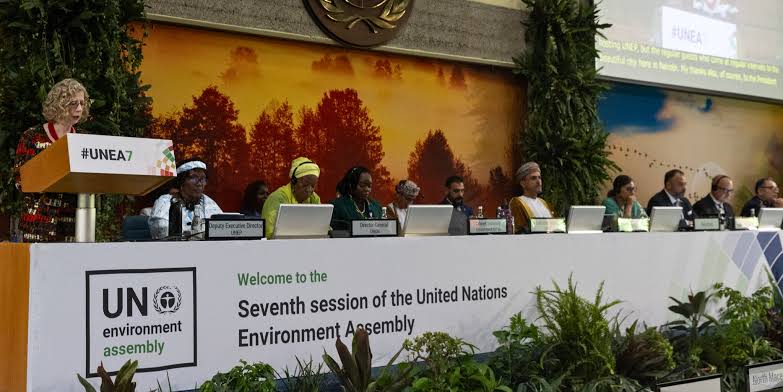
The Seventh Session of the United Nations Environment Assembly (UNEA-7) opened in Nairobi with a powerful call for renewed global solidarity and urgent environmental action, as UNEP Executive Director Inger Andersen warned that the world is running out of time to avert escalating climate and ecological crises.
Speaking at the high-level opening segment, Andersen welcomed delegates to Kenya, home to UNEP for 53 years, and underscored the country’s longstanding support for global environmental governance. “Welcome to beautiful Nairobi, the environmental capital of the world,” she said, thanking donors, Member States and partners who made the Assembly possible.
UNEA-7, the world’s highest decision-making body on the environment, brings together ministers, heads of state, civil society, scientists, youth, Indigenous Peoples, businesses and industry leaders. The Assembly aims to build on decades of multilateral environmental achievements while negotiating new resolutions on critical challenges facing the planet.
A Stark Warning From Science
Andersen highlighted findings from the newly released Global Environment Outlook (GEO-7), UNEP’s flagship scientific assessment. The report warns that environmental degradation already claims millions of lives and costs the global economy trillions of dollars each year. Continuing on the current path—marked by fossil fuel dependence, deforestation, pollution and unsustainable resource extraction—will reduce global GDP, exacerbate inequality, and worsen human health outcomes.
“If the world continues down this path, the damages will mount further,” she said. “We will burn through the natural resources that keep economies and businesses afloat.”
Yet the report also offers hope. Investing in climate stability, healthy ecosystems, fertile lands and clean environments could generate significant economic benefits, prevent millions of deaths, reduce poverty and enhance climate justice.
“Reinforcing environmental action is not a cause to be postponed,” Andersen stressed. “It is a growth strategy and a justice imperative.”
Multilateralism Under Pressure — but Still Delivering
UNEA-7 convenes at a time of deep geopolitical divisions, but Andersen insisted that multilateralism remains indispensable. She pointed to historic successes led by UNEP, including the Vienna Convention and Montreal Protocol that healed the ozone layer, and the Assembly’s role in launching global negotiations on plastic pollution.
“This is multilateralism at its best,” she said. “Complex, of course, but indispensable.”
On the sidelines of the Assembly, presidents of Multilateral Environmental Agreements met to explore deeper cooperation and more coordinated global action across climate, chemicals, waste, biodiversity and pollution.
Resolutions Signal New Momentum
UNEA-7 is considering a series of resolutions that could shape future global commitments. These include safeguarding coral reefs, addressing sargassum seaweed blooms, promoting sustainable solutions through sport, and strengthening the sound management of minerals and metals — an issue that gained urgency with the launch of a new UN taskforce on critical energy transition minerals.
“These resolutions show that even in turbulent times, nations can come together to address environmental challenges,” Andersen said.
A Call to Protect the Most Vulnerable
Andersen reminded delegates that behind every decision taken at UNEA-7 are communities facing deadly floods, droughts, heatwaves and degraded lands. She urged Member States to align words with action and deliver outcomes that protect the world’s most vulnerable populations.
“The world expects this Assembly to protect vulnerable people, not leave them to face climate disasters alone,” she said.
A Defining Moment
As the Assembly begins its deliberations, Andersen appealed to delegates to look beyond immediate political tensions and chart a long-term vision for a stable, healthy and sustainable planet.
“Every year we postpone ambitious, science-based decisions, the cost of inaction grows,” she warned. “History will judge UNEA-7. Let it be said that here, in Nairobi, the world chose to act at the scale these crises demand.”
UNEA-7 continues throughout the week, with negotiations expected to produce a set of resolutions shaping the global environmental agenda for years to come.