



By Joseph Abuje
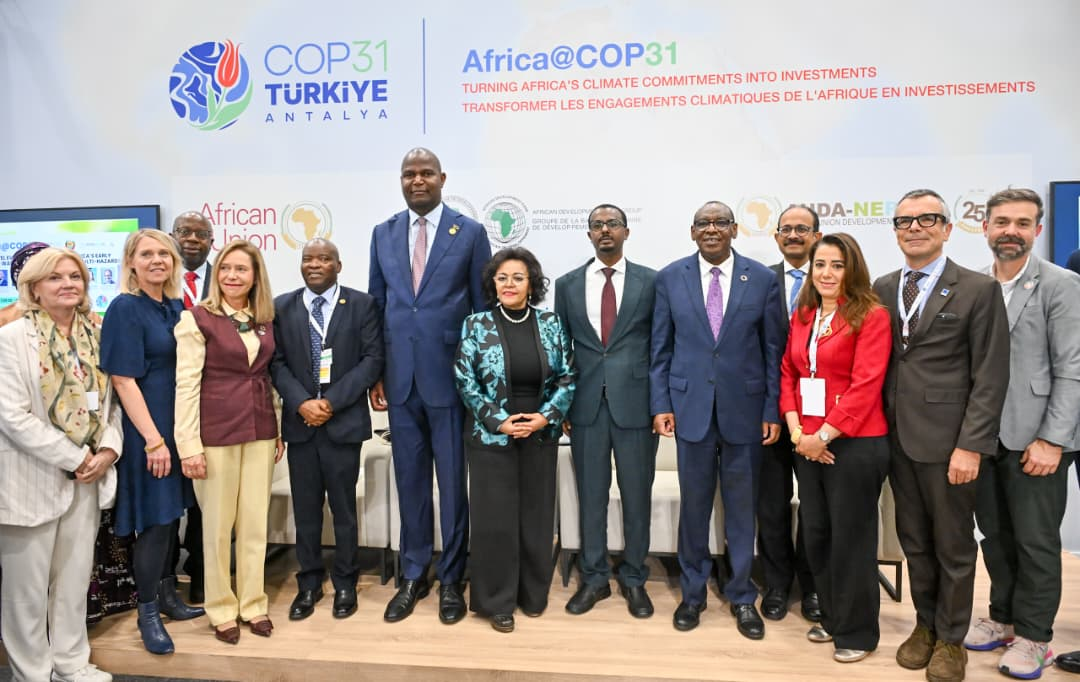
As negotiators in Antalya make a push to turn the just transition mechanism agreed in Belém from words into design, the Economic Commission for Africa (ECA) convened its flagship COP31 event at the Africa Pavilion centered on the question: who pays for Africa’s transition, and who decides?
The answer, panellists agreed, will determine whether the Belém Action Mechanism becomes a genuine instrument of justice or another layer of an economic model that has long exported Africa’s value and imported its costs.
“Africa contributes less than 4 per cent of global emissions, yet it carries some of the heaviest climate costs,” said Mekalia Aklilu, ECA Research Officer for Energy Systems, Financing and Just Transitions. “Sub-Saharan Africa is home to 86 per cent of the world’s people without electricity, up from 49 per cent in 2010. For a woman running a small food business where the power cuts out daily, a just transition is not a mechanism. It is a reliable connection, at a price she can pay, with a say in how it reaches her.”
The numbers behind the debate are stark. Africa needs an estimated USD 277 billion a year to deliver its climate plans, yet only about 11 per cent of that is met. Of every USD 100 of global climate finance, just USD 3 to 4 reaches the continent.
Speakers stressed that the terms of finance matter as much as its volume. With 42 per cent of Africa’s external debt owed to private creditors on market terms, borrowing to adapt to a crisis the continent did not cause compounds the injustice.
Ms. Aklilu put it plainly: finance must be predictable, adequate and accessible and must not deepen debt.
“Africa faces a double penalty,” said Fatima Denton, Visiting Professor at the London School of Economics, who moderated the session. “The costs of climate change are transferred to the continent, and now it must borrow to find its feet.”
For her part. Wanjira Mathai, Managing Director for Africa and Global Partnerships at the World Resources Institute, warned that “just transition” risks meaning everything to everyone unless the most vulnerable define it. “You cannot transition from energy access you do not have,” she said, calling for a deliberate power shift of decisions and finance to the local level. “Decisions made far from communities inevitably cost more and are often wrong.”
Jean-Paul Adam, Director of Policy, Monitoring and Advocacy at the Office of the Special Adviser on Africa, argued that Africa needs transformation, not merely transition. “Our economic model is rooted in raw materials produced for use elsewhere. Equity requires value addition — in communities, as Agenda 2063 sets out.”
The panel heard evidence that change is possible. In Seychelles, a debt-for-climate swap placed proceeds in a trust fund that community organisations could access directly. In Burkina Faso, commune-level accounts allow citizens to follow the money. In Uganda, parish-level climate committees do the same. The LIFE-AR initiative, led by the least developed countries themselves, aims to mobilise around USD 800 million by 2030, with 70 per cent of it reaching the local level.
South Africa’s experience with the Just Energy Transition Partnership offered its approach. Errol Andile Mlambo, Commissioner at the Presidential Climate Commission, said the country now tracks every rand of grant, concessional and commercial finance, and has learned hard lessons: finance must be matched to mapped needs to avoid debt traps; early criteria excluded small businesses and farmers; and consultation must become genuine participation, bringing workers and the informal sector into the room.
Masego Madzwamuse, Managing Director of Quadrature Climate Foundation, said philanthropy can help close the equity gap, but only if it funds those most affected, through African-led institutions close to communities. “Funding built on anything less than trust risks entrenching the very inequities it seeks to solve,” she said, calling for patient capital that recognises transformation takes a decade or more.
Carina Bachofen of the International Institute for Environment and Development added that accountability must run in both directions: countries should be told clearly what funding is on the table, then set out how they will use it — and be answerable for results.
Closing the session, Cosmas Ochieng, Director of ECA’s Climate Change, Food Security and Natural Resources Division, said the conversation does not end in Antalya. ECA will convene a post-COP31 review in mid-December, and in March will bring together African finance, economic planning and environment ministers with global climate funds and development banks, the first convening of its kind, with the aim of closing the conceptualisation, financing and equity gaps in the just transition agenda before COP32.
“A transition designed in Africa, decided elsewhere and judged by people who never live with its costs cannot be called just,” Ms. Aklilu said. “What counts is not what is pledged, but what is delivered afterwards. Equity is the purpose, finance is the means, and accountability is the test.”