





By Edwin Austin
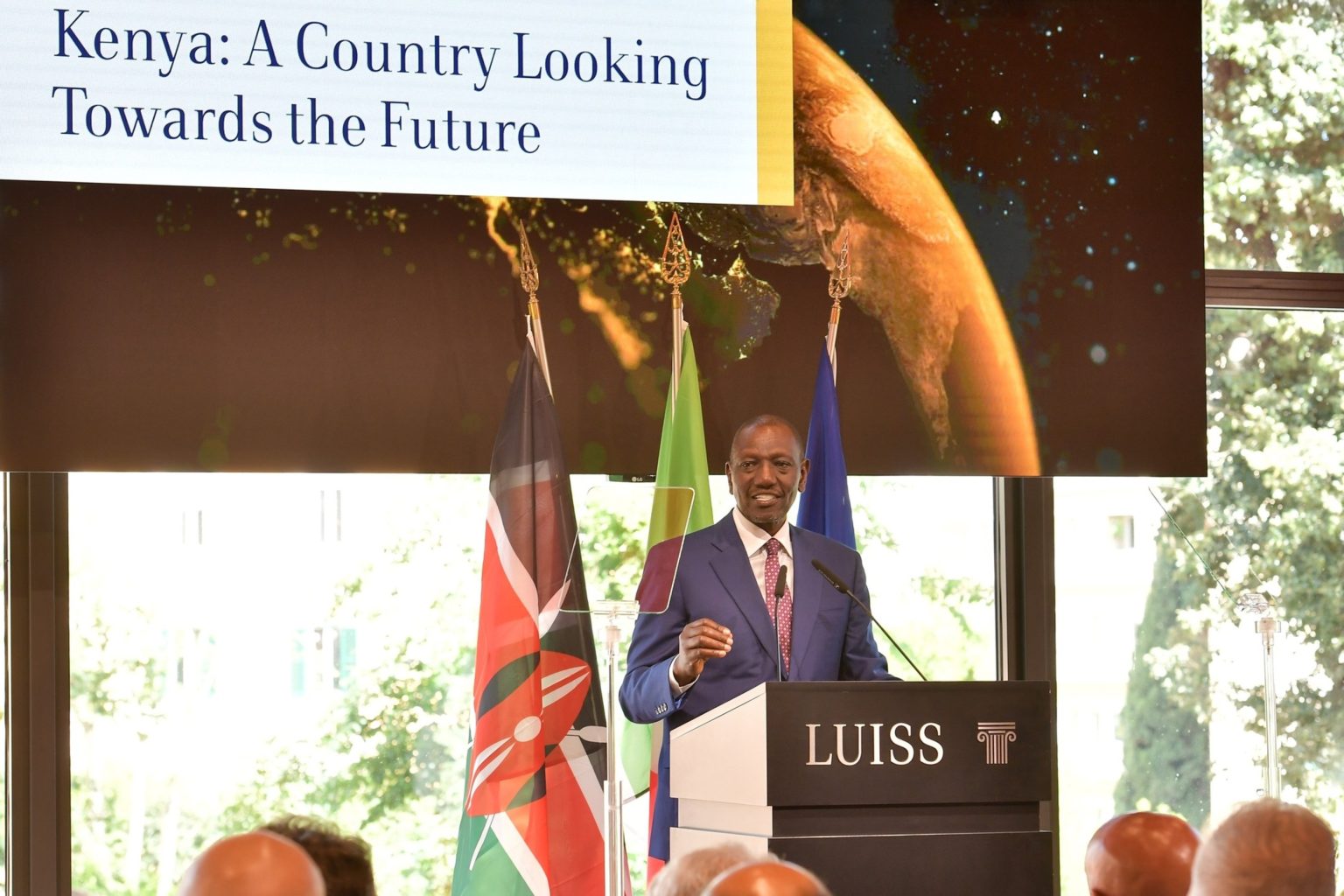
In a timely address delivered at Rome’s LUISS School of Government on April 21, 2026, President William Ruto outlined a comprehensive and ambitious vision for Kenya’s transformation, firmly positioning Kenya as a dynamic and future-ready nation.
His speech, given during a state visit to Italy aimed at strengthening bilateral partnerships and securing investment in key development projects, underscored Kenya’s commitment to navigating global disruptions through innovation, resilience, and bold ambition.
President Ruto began by framing the current era as one defined by rapid technological change, climate pressures, geopolitical uncertainty, and growing demands for effective governance.
Rejecting complacency, he emphasized that Kenya is not managing decline but “governing through disruption,” a deliberate strategy anchored in five key principles, and that is; responsiveness, collaboration, innovation, resilience, and ambition.
This approach seeks to transform governance through digital technology, enabling services to become more accessible, transparent, and responsive to citizens’ needs. Highlighting the social dimension of Kenya’s progress, he noted significant achievements, including expanding publicly funded health insurance coverage from fewer than 8 million to more than 30 million Kenyans.
Central to Kenya’s transformative agenda are three pillars that will drive economic growth and development. First is a massive expansion of infrastructure: over the coming decade, Kenya plans to more than double its paved road network while modernizing airports, seaports, and logistics hubs.
Second, agricultural transformation is a national priority, with the planned construction of at least 50 mega dams to irrigate more than 2.5 million acres, unlocking vast agricultural potential and supporting food security and export-led growth.
Third is a bold energy revolution: Kenya aims to more than triple its installed electricity capacity within seven years, building on its current status as an African leader in renewable energy, where over 90 percent of electricity generation is from clean sources such as geothermal and wind power.
Reliable, affordable power is essential to drive industrialization and technology adoption, which President Ruto identified as critical for realizing Kenya’s ambition to become a first-world economy within a generation.
To finance these ambitions sustainably, the President announced innovative financing models that leverage partnerships between the public sector and both domestic and international private investors.
Through Kenya’s National Infrastructure Fund and Sovereign Wealth Fund, the government is mobilizing an estimated €33 billion to support commercially viable projects without adding undue strain on public debt or taxpayers.
Beyond Kenya’s borders, the President positioned the country’s progress as intrinsically linked to Africa’s collective advancement. He called for Africa to move from the margins to the forefront of the global order, embracing greater economic integration through AfCFTA, which represents a single market of 1.4 billion people with a combined GDP of $3.7 trillion.
President Ruto stressed that expanding intra-African trade, manufacturing, and value addition is critical to transforming the continent’s economies and creating millions of jobs, especially for Africa’s youthful population, where 12 million young people enter the workforce annually but only about 3 million formal jobs are created.
Industrialization, he argued, is the vital pathway to converting demographic pressure into a demographic dividend and sustainable development.
Yet, persistent global challenges remain. President Ruto sharply criticized structural biases in the international financial system, which impose disproportionately high borrowing costs on African countries due to risk assessment frameworks calibrated to advanced economies.
He called for urgent reforms to create a fairer, more responsive global financial architecture, one that recognizes Africa’s resilience, reform momentum, and growth potential. On climate change, Kenya’s leadership by example was a centerpiece: with more than 90 percent of electricity generated from renewable sources, Kenya exemplifies how green growth can be an economic opportunity.
Nonetheless, President Ruto urged the international community to match ambition with tangible action, including enhanced climate finance and equitable access to clean technologies, to support African countries in scaling green industrialization and resilience.