





By Lenah Bosibori
As climate impacts intensify across Africa, Kenya is turning to the high seas for solutions, backing a bold proposal to tax global shipping emissions in a bid to unlock new climate financing for vulnerable nations.
Shipping, a major contributor to global carbon emissions, is emerging as a key focus in Kenya’s push for innovative climate financing.
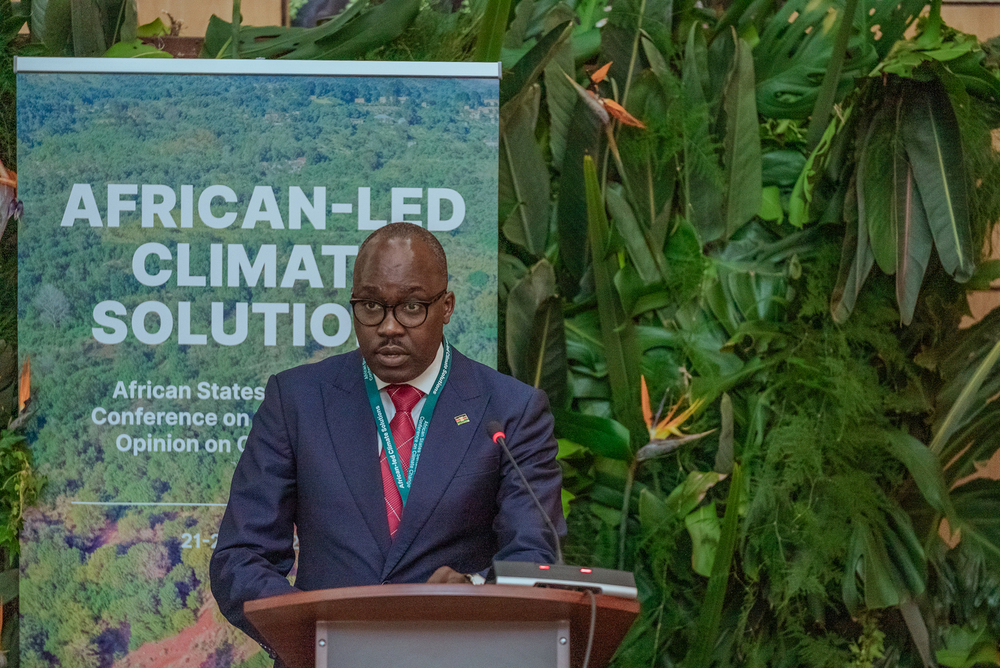
Speaking in Nairobi during a high-level sensitization conference on state obligations in addressing climate change, Dr Korir Sing’Oei, Principal Secretary, State Department for Foreign Affairs, Ministry of Foreign and Diaspora Affairs, said the shipping sector accounts for a significant share of global emissions and must be part of the transition to greener solutions.
“To provide incentives for shipping companies and operators to transition to green energy, we are pushing for the establishment of a solidarity levy of about 0.1 percent on shipping-related income per ton,” he said.
Kenya, alongside France, several European Union countries, and a coalition of African states, is advocating for the introduction of a global solidarity levy on shipping emissions under the International Maritime Organization.
The proposed levy would be used to establish a dedicated solidarity fund under the International Maritime Organization, with resources channeled through institutions such as the World Bank, International Monetary Fund, African Development Bank, and the African Export-Import Bank. The funds would support climate mitigation and adaptation programmes, particularly in countries across the Global South.
Kenya is among the countries backing the initiative as part of a broader push to unlock new and sustainable sources of climate financing.
However, progress on the proposal has been slow. According to Dr Sing’Oei, discussions at the International Maritime Organization were deferred late last year after member states failed to reach consensus.
“The issue is expected to return in the next session, where Kenya and its partners are working to build stronger support, especially among African countries, which have taken a leading role in advancing the proposal,” he noted.
Officials say securing global agreement will be critical in expanding climate financing options and strengthening cooperation between the Global North and South in addressing the growing climate crisis.
Sing’Oei spoke during the African-led climate solutions forum dubbed the African States Sensitization Conference on the ICJ Advisory Opinion on Climate Change, held from April 21–23 in Nairobi.
The conference has brought together senior government officials from East Africa and the Horn of Africa, alongside representatives from the East African Community, African Union Commission, the United Nations and its agencies, as well as international legal experts, judicial officers and civil society organizations.
The meeting is informed by the Advisory Opinion issued on July 23, 2025 by the International Court of Justice, which affirms that states have binding legal obligations to protect the climate system and may face consequences for climate-related harm.
“These ruling changes the rules of the game. Climate commitments are no longer political choices. They are legal obligations, and states will be held accountable. For Kenya, this means accelerating implementation, strengthening enforcement, and ensuring that climate action is fully integrated into our development and economic decisions,” said Dr Sing’Oei.
Building on this landmark ruling, leaders are calling for urgent action to translate this legal momentum into practical, Africa-led solutions for communities on the frontlines of climate change. They note that the ruling strengthens Africa’s position not as a victim, but as a leader shaping solutions and demanding accountability.
“Climate change is not only an environmental issue or a legal issue. It is fundamentally a human and development issue. Addressing it requires science, law and policy to work together, so that we can move from principle to action and deliver real solutions for communities,” said Éliane Ubalijoro, Chief Executive Officer of the Centre for International Forestry Research and World Agroforestry (CIFOR-ICRAF).
Africa contributes less than 4 percent of global greenhouse gas emissions, yet the continent faces some of the most severe climate impacts. Rising temperatures, prolonged droughts, and extreme flooding continue to drive food insecurity, displace communities, and damage critical infrastructure.
“The ICJ advisory opinion is a game changer. It affirms that states are bound by international law and can be held accountable. The challenge now is implementation and ensuring countries have the financing needed to deliver on their climate goals,” said George Wamukoya, Team Leader at the African Group of Negotiators Experts Support.
Despite these challenges, experts note that Africa is already advancing solutions, from climate-smart agriculture and agroforestry to renewable energy expansion and community-led adaptation strategies.
However, a persistent gap between climate needs and available financing remains a major concern. While global mechanisms such as the Loss and Damage Fund have been established, current pledges fall far short of the hundreds of billions of dollars required annually by developing countries.
With global climate financing still inadequate, Kenyan officials say initiatives such as the maritime levy could provide a new, scalable source of funding while holding high-emission sectors accountable.
As global climate negotiations continue, Kenya is positioning itself at the forefront of efforts to turn legal commitments into tangible climate action both on land and at sea.