



By Jim Maina
Universities have been challenged to accelerate the commercialization of research and innovation to create jobs, enterprises and practical solutions to Africa’s development challenges.
Education Cabinet Secretary Hon. Julius Migos Ogamba said institutions of higher learning must ensure promising innovations move from laboratories to the market, as universities face growing pressure to demonstrate the economic value of their research.
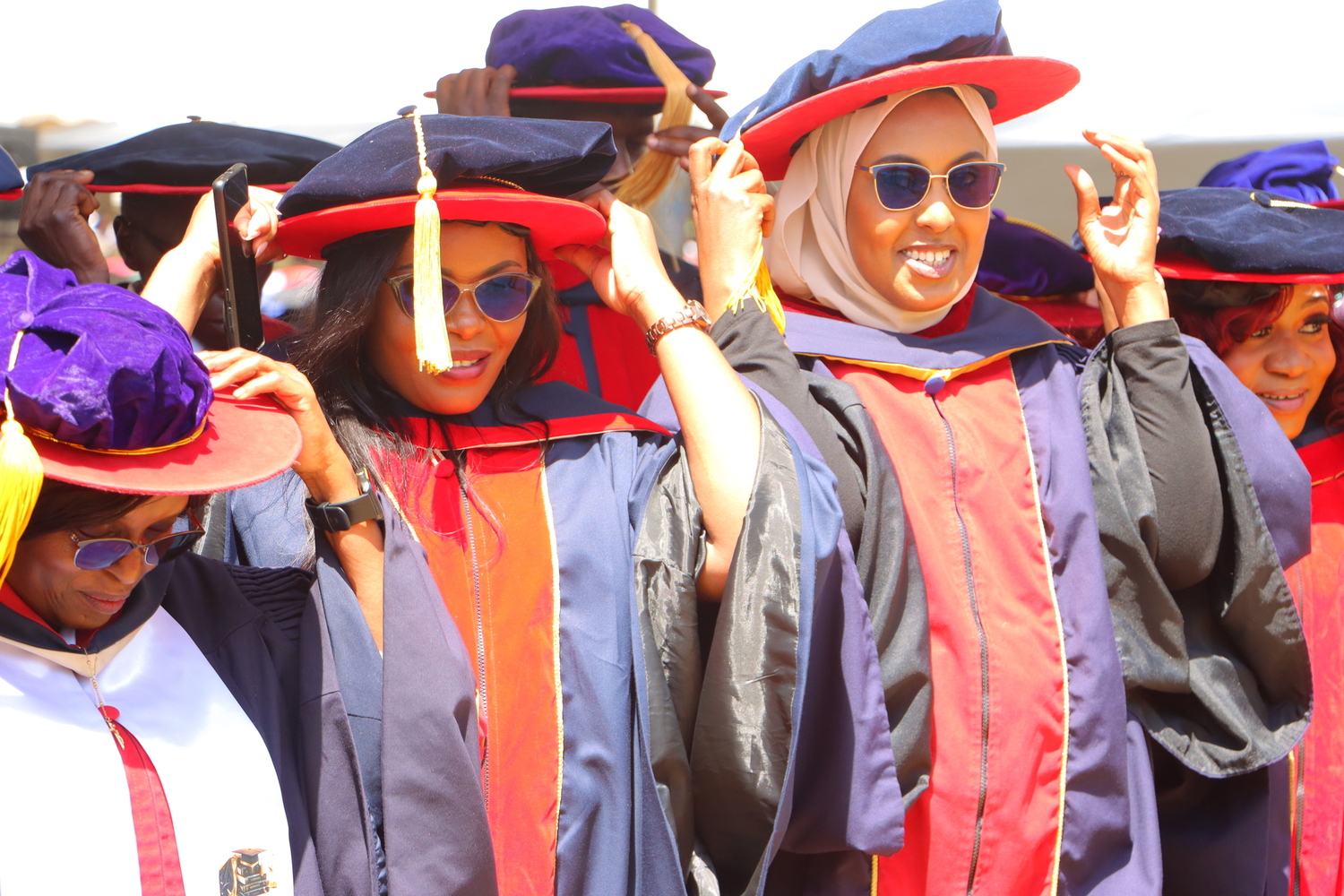
He spoke during the joint Graduation Ceremony of Jomo Kenyatta University of Agriculture and Technology (JKUAT) and the Pan African University Institute for Basic Sciences, Technology and Innovation (PAUSTI) where 5,035 students graduated on Friday August 14, 2026.
In a speech read on his behalf by Principal Secretary for Technical, Vocational Education and Training, Dr Esther Thaara Muoria, Hon. Ogamba said universities must deliberately scale up innovations with commercial potential.
“As we strive to deliver on this role, I call upon our institutions of higher learning to make deliberate efforts to scale up promising innovations and translate them into viable products, services and enterprises,” said the CS.
Hon. Ogamba urged universities to effectively prepare for the transition to Competency-Based Education, whose first cohort is expected to enter universities in 2029.
JKUAT Vice Chancellor Prof. Victoria Wambui Ngumi said the University was harnessing partnerships to turn research into solutions, including contributing to Kenya’s National AI Strategy, developing cleaner maritime technologies, improving potato production and connecting dairy farmers to markets.
Prof. Ngumi said JKUAT was also aligning its academic programmes with emerging national and global needs, having introduced the Bachelor of Communication and Marketing, Bachelor of Science in Revenue Administration and Technology, Bachelor of Science in Chemical Engineering and Bachelor of Science in Nautical Science.
“We are also embedding outcome-based education in our engineering programmes as we work towards their accreditation under the Washington Accord,” said Prof. Ngumi.
JKUAT Chancellor Prof. Joseph Mathu Ndung’u said the University was placing greater emphasis on research that delivers real-world impact, pointing to work in agricultural biotechnology, artificial intelligence, bioinformatics and climate-resilient agriculture.
He said the ultimate test of university research was its ability to improve lives beyond academic publications.
“Such work reminds us that the finest university research does not end with publication. It finds its way into farms, enterprises, public institutions and households, where it can improve livelihoods and widen opportunity,” said Prof. Ndung’u.
He also cited JKUAT’s growing international standing, including its designation as a regional hub for software testing and quality assurance and its distinction as the first university in the region to offer International Software Testing Qualifications Board certification.
JKUAT Council Chair Dr. James Micah Onsando said that JKUAT had joined the United Nations Artificial Intelligence Capacity Development Network as a founding member, strengthening opportunities for collaboration in AI skills development, computing infrastructure, data governance and responsible use of the technology.
On the intellectual property front, Dr. Onsando noted that JKUAT had secured one patent and four copyright registrations in the six months preceding the graduation, covering agriculture, engineering, health, digital systems, renewable energy and manufacturing.
“Our next task, therefore, is to accelerate the journey from laboratory and workshop to market and community, so that research contributes not only to knowledge creation, but also to jobs, new enterprises, improved services and sustainable revenue for the University,” said Dr. Onsando.
He appealed for support to rehabilitate the University’s internal road network and find a lasting solution to periodic flooding that disrupts movement and affects operations within the University.
Dr. Onsando welcomed the Government’s commitment to construct a hostel under the Affordable Housing Programme at JKUAT, urging the relevant authorities to expedite its completion.
PAU Vice Rector, Academic and Student Affairs, Prof. Bolanle Idowu Akeredolu, urged graduates to apply their knowledge beyond the university and embrace innovation and entrepreneurship as they enter the wider economy.