





By Edwin Austin
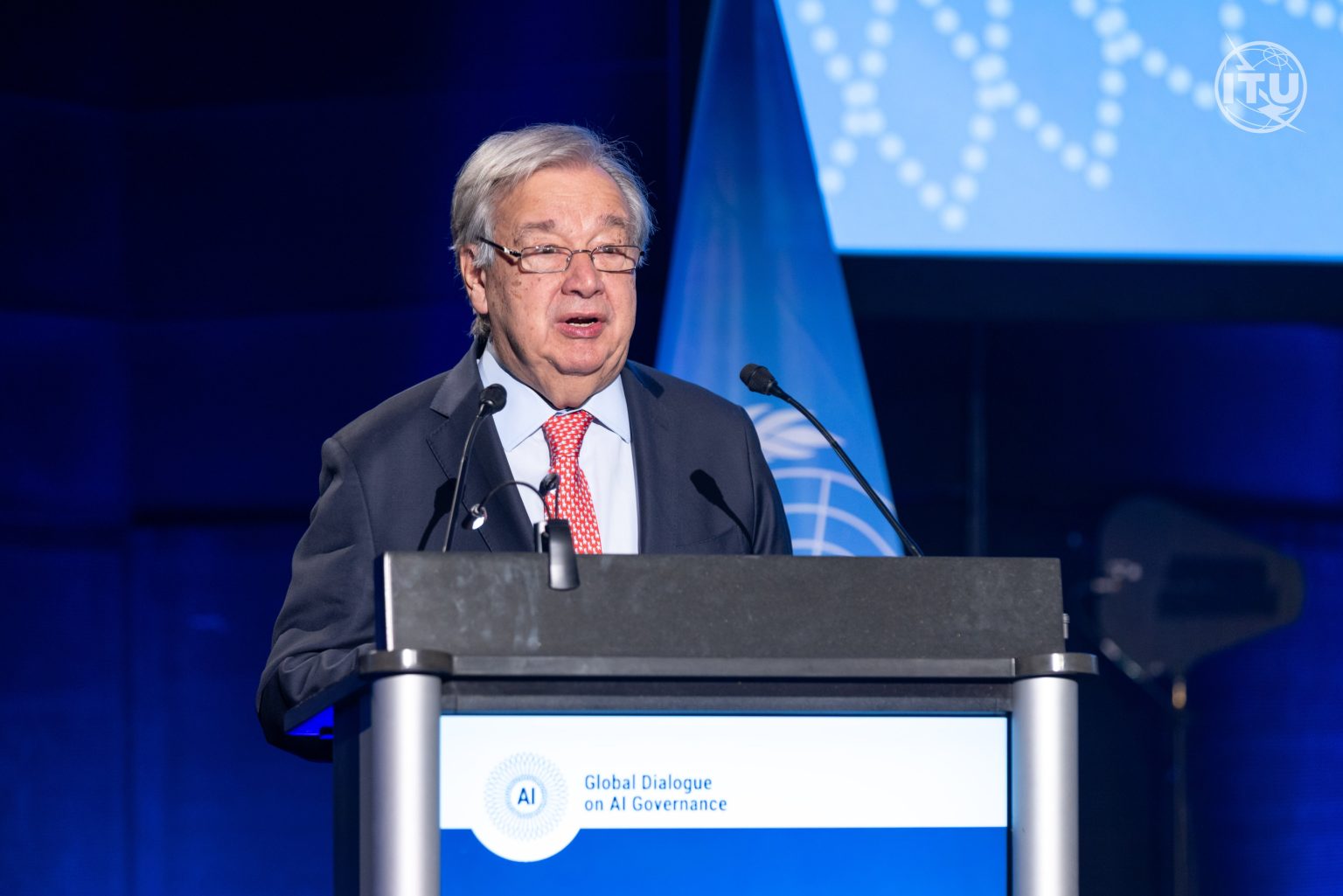
At the inaugural United Nations Global Dialogue on Artificial Intelligence Governance in Geneva held on the 6th day of July, 2026, the UN Secretary-General, António Guterres, unveiled a landmark AI Child Safety Pledge aimed at safeguarding children from the growing risks posed by artificial intelligence.
In a powerful address to representatives from more than 90 nations, the Sec-Gen warned that AI “has reached our children, their learning, their friendships, their most private questions before anyone asked what it would do to them,” highlighting a troubling reality where rapidly advancing technology outpaces protections and oversight.
With alarming consequences already unfolding where the world has witnessed children being deceived by machines posing as friends, steered towards self-harm, and exposed to abuse images created at the touch of a button, the Secretary-General left no doubt when he asserted, “No child should be a guinea pig for unregulated AI.”
The Secretary-General’s AI Child Safety Pledge sets three clear, non-negotiable rules for any AI system accessible to children. First, that companies must “prove it is safe” through child-specific safety testing combined with independent oversight before deployment. Second, that there must be “zero tolerance for sexual abuse,” meaning that no AI should generate sexual images of children and that companies must detect, report, and remove such material without any exception whatsoever. Thirdly, “never leave a child in crisis alone,” was the Sec-Gen’s rule, mandating that AI systems recognizing signs of distress should immediately stop and connect the child to real human support. He underscored this point by stressing, “When a child is harmed, the answer must never be, the algorithm did it.”
This pledge emerges from the Secretary-General’s broader call for global alignment on AI governance, warning that when countries fail to coordinate on testing systems, measuring risk, and assigning responsibility, a “patchwork of incompatible rules raises costs, divides the world and protects no one.” António Guterres argued for common baselines for frontier systems, common methods to evaluate and verify risks, and common resolve that systems with global reach must meet standards worthy of global trust. The push for protecting children is central to this mission, as Guterres noted, “Nowhere does safety matter more than for those least able to protect themselves, our children.
” Alongside the pledge, the Secretary-General highlighted other crucial priorities in AI governance, including the protection of human rights, noting “AI must never strip away dignity or entrench discrimination,” and insisting that “in every high-stakes decision, machines can inform, but humans must decide and answer.”
Also most forcefully, the Secretary-General condemned autonomous weapon systems, calling them “killer robots,” machines that select and engage targets without human oversight, labeling such technology as “morally repugnant” and “politically unacceptable.”
Guterres urged states to ban these weapons under international law and warned, “Some decisions must remain forever human, none more than taking a human life.” Suffice it to say, the introduction of the AI Child Safety Pledge sends an unmistakable message that protecting children must be at the forefront of AI governance.
As the UN dialogue continues in Geneva and then next year in New York, the world will watch closely to see how this pledge translates into policies and concrete protections, ensuring AI truly develops by humanity, with humanity and for all humanity.