




By Lenah Bosibori
Kenya has vaccinated more than 10 million livestock across 31 counties as the government accelerates efforts to modernize livestock farming, strengthen food security, and position farmers to access lucrative international markets.
The nationwide campaign, targeting major livestock diseases, marks one of the country’s largest animal health interventions and signals a broader shift from traditional subsistence farming to a technology driven and market-oriented livestock sector.
Speaking during a Food Systems Leadership forum in Nairobi, Principal Secretary for Livestock Development Jonathan Mueke said the government is prioritizing preventive animal healthcare as part of the Kenya Kwanza administration’s Bottom-Up Economic Transformation Agenda.
“We decided to move from being reactive to preventive. If animals are healthy, farmers can produce more and access better markets,” said Mueke.
The vaccination programme focuses on controlling Foot and Mouth Disease in cattle and Peste des Petits Ruminants (PPR) in sheep and goats, diseases that have historically weakened livestock productivity and limited Kenya’s export potential.
Although the programme initially faced resistance and misinformation, Mueke said farmers gradually embraced it after realizing the economic value of protecting their animals.
“Farmers understand the pain of losing livestock because that is their livelihood. Quietly, many of them accepted the programme because they saw the benefits,” he said.
The government is now integrating digital systems into livestock management through the rollout of the national Animal Identification and Traceability System known as ANITRAC.
The platform uses Radio Frequency Identification (RFID), a technology that uses electronic tags and radio waves to digitally identify and track animals throughout their lifecycle.
Under the system, livestock can be traced from farm to market, allowing authorities and buyers to monitor animal health records, vaccination history, movement, and ownership.
“Consumers today want to know where their food comes from. Traceability is becoming a global requirement for market access,” Mueke said.
The system has already been piloted in six counties and is expected to launch nationally by the end of June alongside new legislation governing livestock identification and tracking.
Kenya is also investing in genetic improvement programmes through artificial insemination, embryo transfer, and community breeding initiatives aimed at producing drought resistant and high yielding animals.
“We want farmers to keep more productive animals that can produce more milk or meat while using less feed,” Mueke said.
To address recurring drought related livestock losses, the government is establishing strategic animal feed reserves and encouraging large scale commercial fodder production through partnerships with the private sector.
The reforms come as Kenya seeks to expand exports to international markets including the European Union, the United Arab Emirates, China, and countries under the African Continental Free Trade Area.
According to Mueke, inconsistent supply, weak standards, and poor organization within the livestock value chain have prevented Kenya from fully benefiting from these opportunities.
“Half of the global GDP market is now open to Kenyan goods and services. The challenge is whether we can consistently meet the quality and quantity required,” he said.
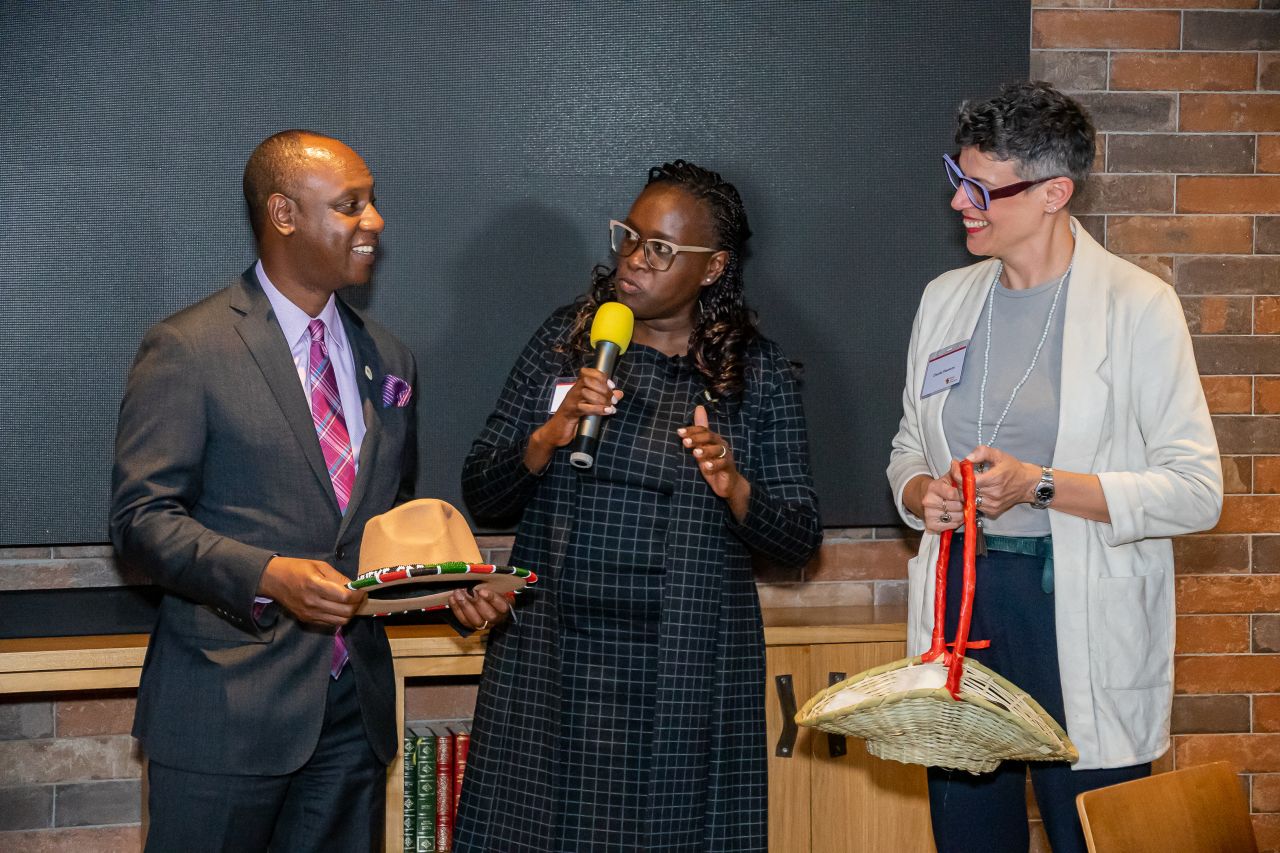
The forum dubbed Strategic Exchange on livestock Development with the PS Mueke brought together food systems leaders under the African Food Fellowship, a pan African leadership programme operating in Kenya, Rwanda, and Zambia.
The fellowship supports professionals working in agriculture, policy, research, finance, and innovation to develop long term solutions for Africa’s food systems challenges.
Kenya Country Lead for the African Food Fellowship, Gacoki Kipruto, said the programme was established in 2020 to nurture systems thinking leadership across the continent.
Applicants must demonstrate active involvement in food systems and identify challenges they have struggled to solve using conventional approaches. Selected fellows undergo a 10-month leadership programme focused on three key areas: horticulture, Agri finance, and the blue economy for food.
Kipruto said one of the fellowship’s priorities is strengthening resilience against climate shocks through innovations such as index-based livestock insurance. “When drought hits, livestock keepers lose not only animals but household income and food security. Insurance helps communities recover faster and avoid deeper crises,” she said.
She noted that many agricultural innovations remain trapped within research institutions and universities without reaching farmers and communities that need them most.
The fellowship therefore focuses on translating scientific research into practical solutions while strengthening collaboration between governments, scientists, communities, and markets.
“We do not want science for the sake of science. We want solutions that create real impact for communities,” Kipruto said.
She added that misinformation, cultural perceptions, and weak coordination often slow adoption of agricultural technologies and innovations across Africa. The programme also works to improve financial inclusion within agriculture.
Kipruto highlighted research conducted among women in the blue economy whose work in fish farming and fish trading had remained largely invisible within formal financial systems.
The findings later contributed to the development of an aquaculture insurance product by a Kenyan insurer after financial institutions gained better understanding of the women’s income cycles and risk patterns.
“You cannot build financial products for communities you do not understand. Data and visibility are critical,” she said.
The fellowship has also supported initiatives linking indigenous seed systems with school feeding programmes to improve nutrition while strengthening local food markets.
On youth involvement, Kipruto said young people are increasingly entering agriculture through technology, logistics, aggregation, and digital services rather than traditional farming alone.
“Youth are inspired when they see other young people succeeding in agriculture. Peer influence matters more than simply telling them farming is important,” she said.
Kipruto explained that Artificial Intelligence (AI) can help combine satellite imagery, climate data, and ground information to improve drought prediction, insurance payouts, and early warning systems.
“Satellite imagery alone may show vegetation, but that does not always mean there is usable animal feed. AI helps improve accuracy by combining multiple datasets,” she said.
Despite growing innovation, she acknowledged that agricultural insurance uptake in Kenya remains low due to limited awareness and weak integration of risk management into farming practices.
“Many farmers still think about insurance after a problem happens instead of planning for risk from the beginning,” she said.
Cohort Five of the African Food Fellowship is expected to graduate in July, while recruitment for the next cohort is already underway.